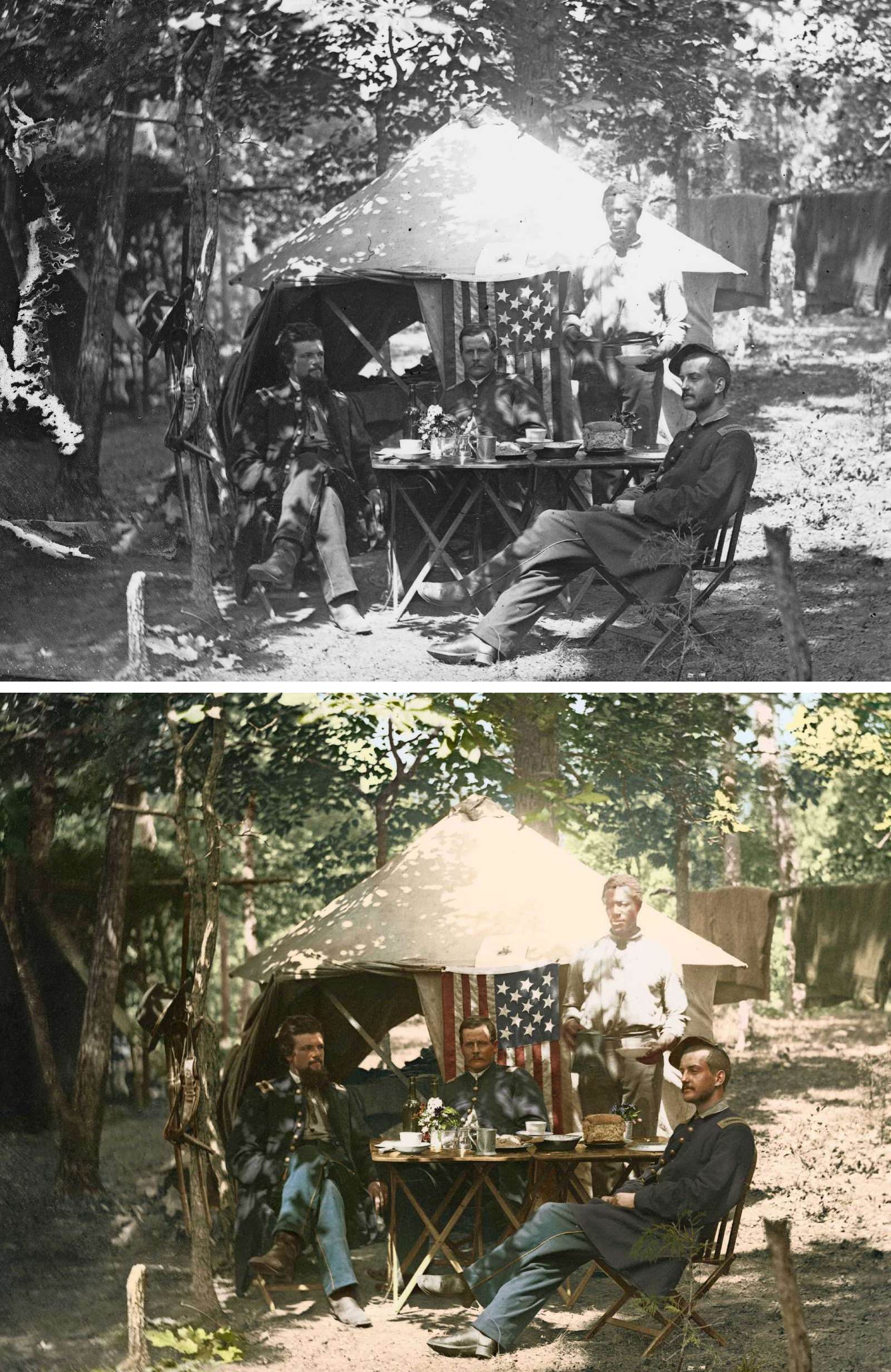
Under the shade of tall trees, the officer’s mess of Company E, 93rd New York Volunteers is arranged like a brief island of order amid the hardships of the Civil War. A canvas tent stands behind a small folding table set with cups, plates, and a prominent loaf of bread, while a U.S. flag hangs at the entrance like a familiar marker of purpose and identity. Three uniformed men lounge in camp chairs—relaxed in posture yet watchful in expression—suggesting a moment stolen between duties rather than true leisure.
Behind them, a fourth figure stands holding dishes, anchoring the scene in the everyday labor that kept military life functioning. The simple props tell the story as clearly as the faces: tinware instead of porcelain, a makeshift dining room instead of a mess hall, and a few personal touches that soften the utilitarian look of the camp. Even the dappled sunlight across the tent reads like a reminder that nature continued on while armies moved and waited.
Titled “Officer’s mess, Company E, 93rd New York Volunteers, in Bealeton, Va., Aug., 1863,” the photograph offers an intimate look at Union Army camp life beyond the battlefield. It’s a valuable Civil War era image for readers interested in military history, soldier routines, and the lived texture of the war—food, shelter, hierarchy, and the quiet rituals of a shared meal. The scene invites you to linger over details and imagine the conversations that might have filled this wooded clearing before the next order arrived.