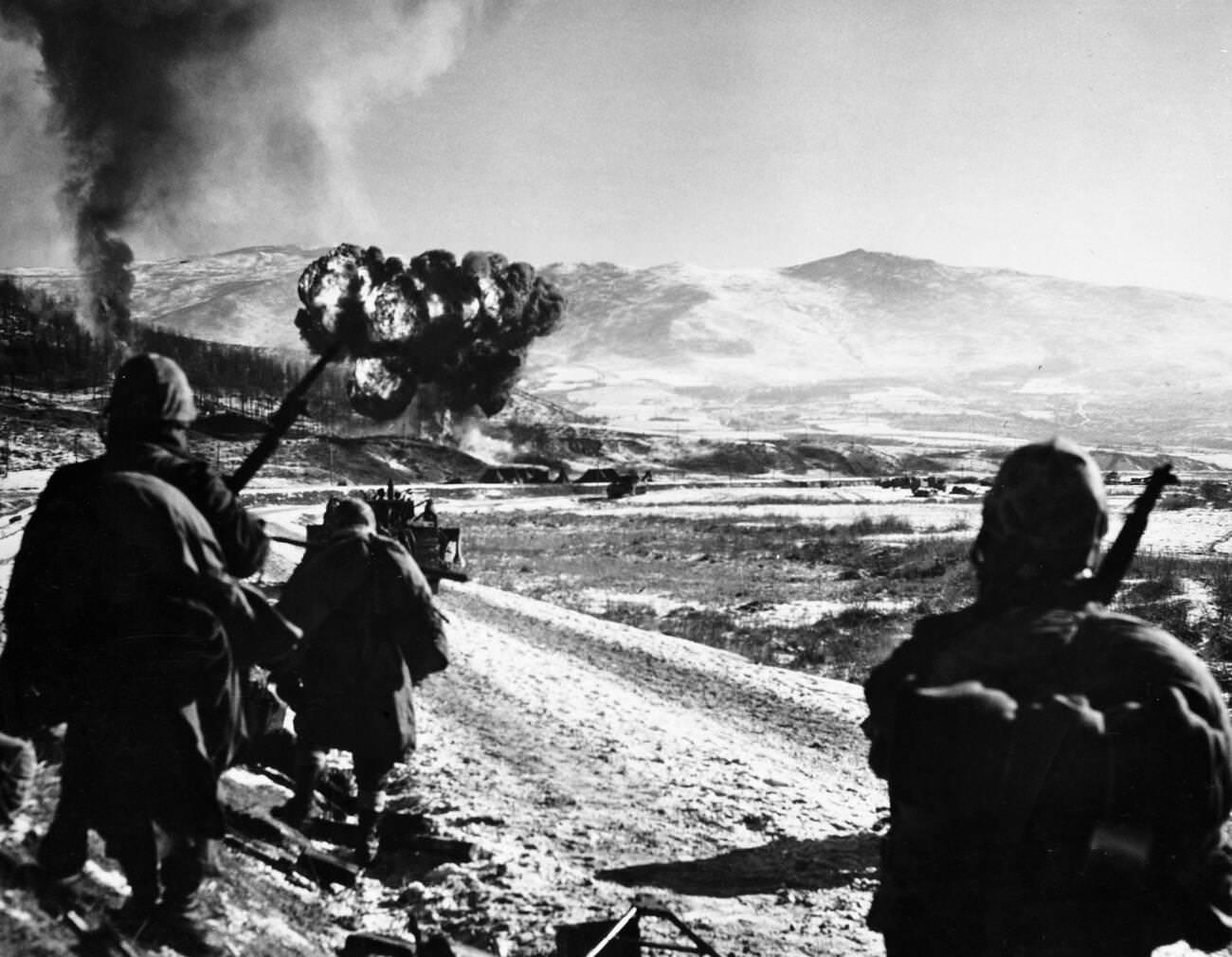
Across a snow-dusted valley, a line of Army soldiers moves forward with rifles slung and shoulders hunched against the cold, while a dark, blossoming explosion punches into the sky ahead. The wide landscape—bare ground, low structures in the distance, and ridgelines rising beyond—makes the men look small, emphasizing how exposed infantry could be on a Korean War battlefield in the 1950s. Smoke trails drift upward, turning the open air into a warning of what lies beyond the next rise.
In the foreground, the troops are seen mostly from behind, a perspective that pulls the viewer into their uncertain advance rather than offering a tidy, heroic pose. Heavy coats and helmets suggest winter conditions, a defining hardship of the conflict, when freezing weather complicated movement, weapons, and survival as much as enemy fire. The contrast between the stillness of the mountains and the violent burst at center frame captures the uneasy rhythm of frontline life—long stretches of marching and waiting punctuated by sudden, overwhelming noise.
For readers exploring Korean War history, this photograph serves as a stark reminder that modern “civil wars” and international conflicts are often fought in ordinary farmland and rugged hills, where civilians’ landscapes become military ground overnight. The scene invites reflection on tactics and terrain: open fields that offer little cover, distant positions that must be guessed at through smoke, and the constant pressure to keep moving despite the danger ahead. As a historical image, it preserves not just a moment of combat, but the atmosphere of a 1950s battlefield—cold, expansive, and unforgiving.