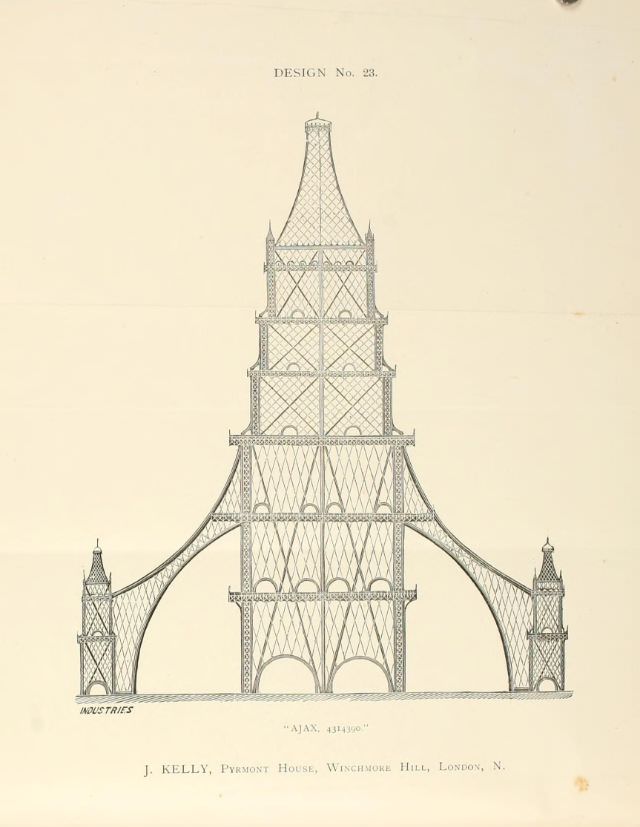
Design No. 23 sits on the page like a confident pitch to the late-Victorian imagination, part of the burst of invention that produced 50+ competitive schemes for a proposed “Great Tower for London.” Rendered as a crisp line drawing, the structure rises in tiered stages with latticed ironwork, arched openings, and a slender crown, marrying engineering bravado with a touch of ornament.
At the base, wide sweeping curves stretch outward into smaller flanking towers, suggesting an effort to balance spectacle with stability while opening the ground level into monumental portals. The repeated cross-bracing and patterned panels read like a catalog of industrial-era materials and methods—an architect’s argument, in ink, that modern metal frameworks could be both functional and beautiful.
Printed details on the sheet—including the “Industries” label and the designer credit to J. Kelly—anchor the image in the world of public competitions, publishers, and ambitious proposals circulated for scrutiny. For readers interested in London history, Victorian architecture, and the story of unbuilt landmarks, this rare tower design offers a vivid glimpse of how the city’s skyline might have been rewritten by 1890-era innovation.