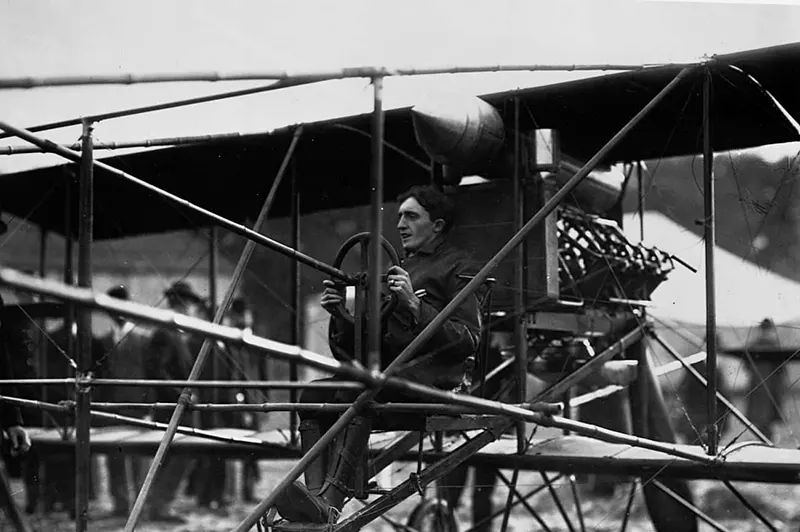
Perched in an open seat amid a thicket of struts and wires, Charles K. Hamilton appears ready to coax an early model airplane into motion. The scene is all exposed framework and fabric wing above, with the pilot’s hands near the controls and his feet set on the narrow structure below. It’s a striking reminder of how close early aviation kept its flyers to the machine—and to the air rushing past.
Behind Hamilton, the aircraft’s engine and mechanical components sit out in the open, hinting at the experimental spirit that defined the era of inventions and flight demonstrations. The biplane’s rigging dominates the frame, forming a geometric web that speaks to the engineering solutions of the time: light materials, bracing cables, and practical craftsmanship rather than streamlined shells. Even the blurred figures in the background suggest a public spectacle, as onlookers gathered to witness what still felt like a daring novelty.
Airplane history often turns on moments like this, when innovation depended as much on courage as on design. Hamilton’s poised posture underscores the hands-on reality of early pilots, who navigated rudimentary controls and unpredictable machines without the protections later generations would take for granted. For readers interested in the evolution of aviation technology, this photograph offers an intimate glimpse into the inventive, improvisational world that helped launch modern flight.