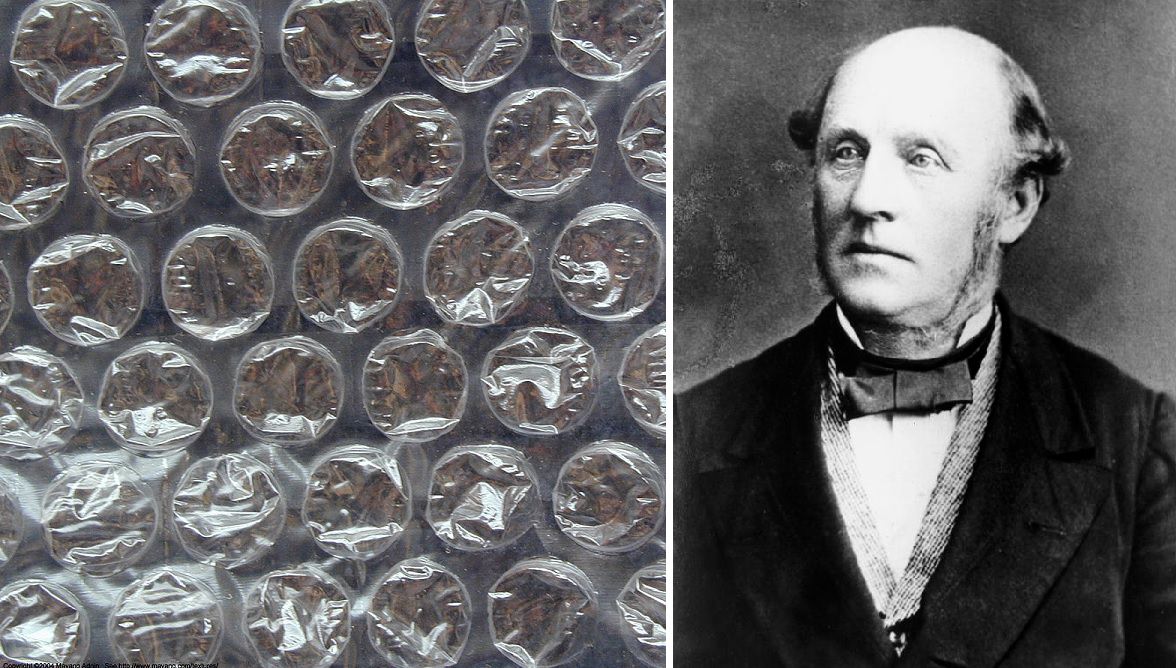
Alexander Parkes stands at the threshold of a material revolution, and the portrait here invites a closer look at the inventor behind “Plastic (1862).” Dressed formally and photographed with the steady seriousness of the era, he represents a generation of experimenters who treated chemistry like a workshop craft, testing, refining, and imagining new substances for an industrializing world. The title anchors the moment without overexplaining it: an early step toward plastics long before they became synonymous with modern life.
Alongside the portrait, the textured field of clear, rounded forms evokes the look of molded or packaged plastic in everyday circulation, a visual reminder of what Parkes’s breakthrough ultimately made possible. Those repeating circles—glossy, wrinkled, and reflective—suggest the strange dual nature of synthetic materials: at once light and durable, practical yet visually uncanny. The pairing of human face and manufactured surface compresses a century and more of change into a single frame.
For readers exploring the history of inventions, this post offers a bridge between Victorian-era innovation and the sprawling story of polymers that followed. Parkes’s 1862 work hints at the earliest ambitions to create a moldable substitute for scarce natural materials, opening doors to mass production, consumer goods, and new design possibilities. Seen today, the image doubles as an origin story for plastic—an invention with an undeniable legacy, both transformative and complicated.