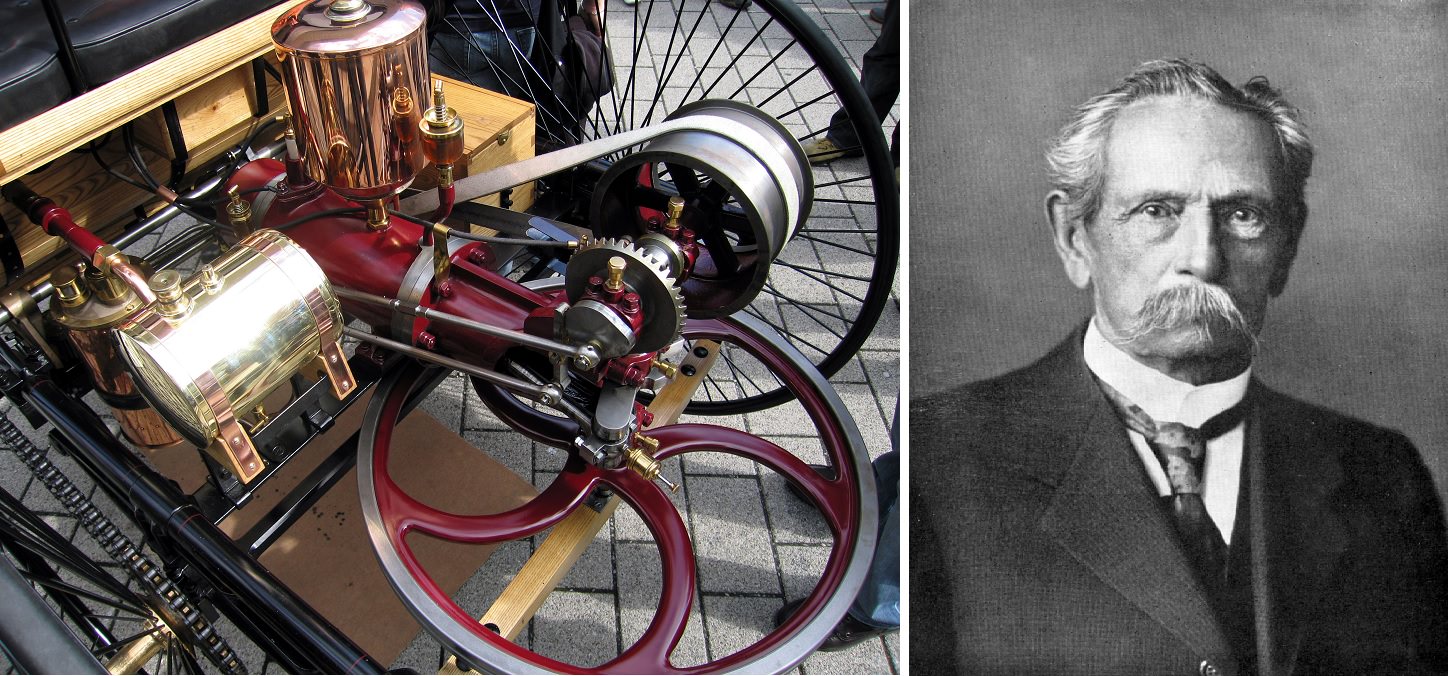
Polished brass cylinders, exposed gearing, and spoked wheels dominate the scene, turning the “motor car” into a readable diagram of early mechanical ambition. Rather than hiding its workings behind bodywork, this 1870s-era machine puts every linkage and reservoir on display, inviting the viewer to trace how power might have been generated, transferred, and controlled. The close view emphasizes craftsmanship—metal fitted to wood, pipes and valves arranged with a watchmaker’s care—hinting at a time when the automobile was still an invention in conversation with bicycles, carriages, and steam-era engineering.
Alongside the machine appears a formal portrait of the inventor credited in the title, presented with the sober dignity typical of nineteenth-century studio photography. The pairing works like a visual argument: the person and the prototype belong together, each explaining the other. Even without a detailed caption, the contrast between human face and intricate mechanism underscores how experimental transport was shaped by individual ingenuity, patient iteration, and the confidence to imagine roads filled with self-propelled vehicles.
For readers interested in inventions and the origins of automotive history, this post offers a compact window into the birth of modern mobility. Details such as the open drivetrain, the prominent flywheel-like forms, and the utilitarian framing help explain why early motor cars looked more like engineered apparatus than comfortable conveyance. As an SEO-friendly snapshot of early automobile technology, it speaks to collectors, historians, and curious visitors searching for Karl Benbz, 1870s motor car designs, and the transitional era when the idea of a car was still being built piece by piece.