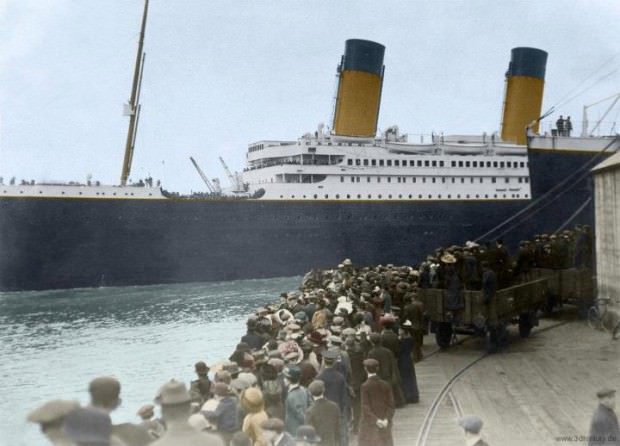
Along the dockside, a dense crowd in brimmed hats and dark coats presses forward to watch a colossal liner loom over the water, its towering yellow funnels and long tiers of windows dwarfing everyone below. The calm surface of the harbor contrasts with the ship’s stark black hull, emphasizing just how unprecedented this scale felt to onlookers seeing modern ocean travel made visible. Even without labels or banners, the scene conveys a moment when technology itself became a public spectacle.
The title “Building the Unsinkable” points back to the shipyard triumphs that made vessels like Titanic possible: precision steelwork, vast internal compartments, and industrial systems designed to tame the Atlantic with confidence and comfort. What fascinates is how the promise of “unsinkable” was never just a claim about safety; it was a marketing shorthand for an era that believed engineering could outrun risk. In the lines of the superstructure and the disciplined repetition of portholes, you can read the new logic of mass production applied to luxury and speed.
Crowds gathering at the quay also tell a story about rise to fame—how a ship became a celebrity before most people ever set foot aboard. This post explores Titanic construction, early public attention, and the inventions and innovations that turned a passenger liner into a symbol of modernity, from the hidden machinery below decks to the carefully planned spaces above. For readers searching Titanic history, shipbuilding, and the origins of twentieth-century maritime engineering, the photograph offers a grounded starting point: awe, anticipation, and the belief that the future had arrived on a tide.