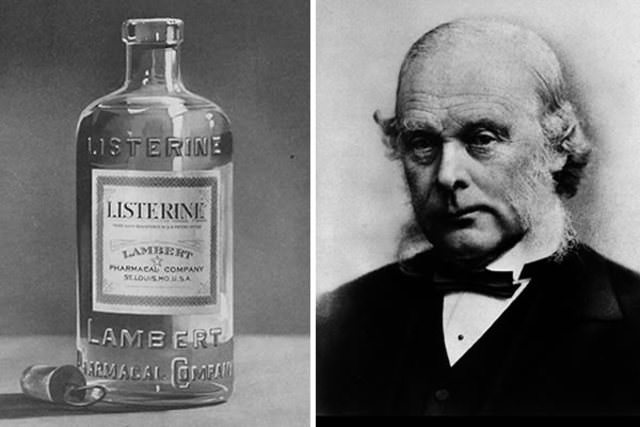
Few medical breakthroughs changed everyday survival as dramatically as antiseptics, and the 1870s are often remembered as the decade when Joseph Lister’s ideas began reshaping surgery and wound care. The portrait here evokes the sober confidence of Victorian science, a period when hospitals were as dangerous as they were hopeful and “infection” was only starting to be understood as something preventable. Lister’s work helped turn cleanliness from custom into clinical method, laying foundations for modern antiseptic practice.
Beside the formal likeness sits a labeled bottle of Listerine, an object that hints at how laboratory thinking and public life gradually intertwined. Glass pharmacy containers like this were designed to be read at a glance, with bold typography and a promise of practical protection in an age newly captivated by germ theory. Even without pinning down a precise year or place, the pairing of face and bottle tells a story of innovation moving from the operating theatre into medicine cabinets.
Readers interested in the history of inventions, Victorian medicine, and the origins of antiseptic solutions will find a rich trail starting with Lister and continuing through the commercialization of disinfectants and mouthwashes. The image serves as a compact visual lesson in how medical authority, branding, and scientific progress reinforced one another. For anyone tracing the evolution of infection control—from carbolic sprays to modern sterilization—this post offers a compelling snapshot of an idea that saved countless lives.