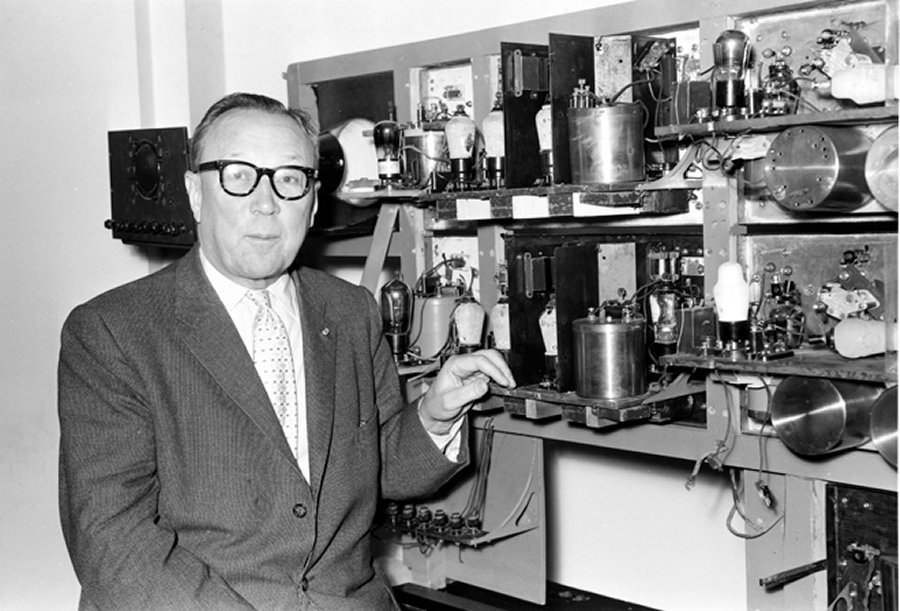
A suited engineer stands beside an open rack of electronics, his hand poised as if mid-explanation, while rows of valves, coils, and metal housings crowd the frame. The dense, modular layout hints at a time when breakthrough ideas were built from bulky components and careful wiring rather than microchips. Tied to the title “Radar (1935) by Robert Watson-Watt,” the scene evokes the early, practical character of radar research—equal parts laboratory craft and bold new theory.
Behind the composed portrait lies a technology that changed how distance and direction could be understood through radio waves. Radar, still an invention in formation during the mid-1930s, depended on transmitters, receivers, and timing equipment that demanded constant adjustment and expert interpretation. The photo’s emphasis on apparatus—stacked shelves, exposed circuits, and a workshop-like environment—underscores how experimental this field remained, even as its potential was rapidly becoming clear.
For readers interested in the history of inventions and the origins of modern sensing, this image offers a tactile glimpse into the foundations of radar technology. It speaks to an era when innovation was visible on the bench: glowing tubes, clattering relays, and the careful arrangement of parts that made detection possible beyond human sight. As a WordPress feature on Robert Watson-Watt and radar in 1935, it invites closer attention to the material culture of science—where world-changing systems began as hardware you could point to, touch, and troubleshoot.