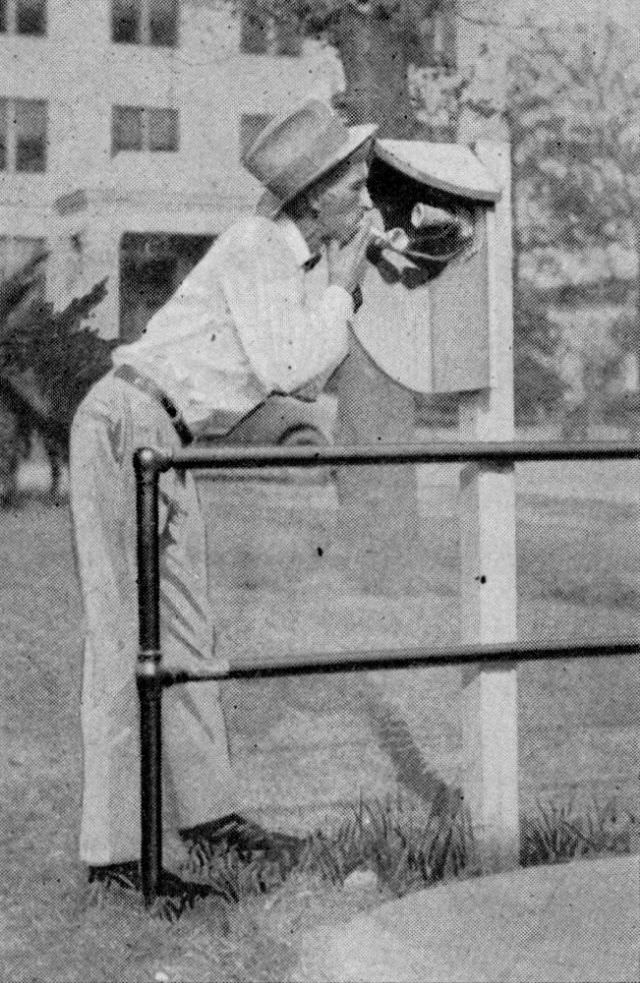
Leaning in with a brimmed hat and a cigarette lighter poised at his mouth, the man in this 1933 scene demonstrates an unusual approach to oil-field security. A small box mounted on a post—shaped like a compact, field-ready instrument—sits within easy reach, suggesting a device meant to be triggered or tested on the spot. The humble railing in front and the open grounds behind hint at a controlled perimeter, the kind of practical setup where a simple alarm could matter.
In the early 1930s, ingenuity often meant working with what was already in a pocket, and the title’s lighter detail points to a clever “spark-to-signal” concept. Whether it was intended to ignite a warning flare, activate a mechanism, or prove a system’s readiness, the idea speaks to an era when new inventions were frequently demonstrated with everyday objects. The photo’s focus on the man’s careful posture emphasizes procedure: watch, approach, engage the device, and move on—routine made visible.
For readers interested in historical inventions, industrial safety, and the culture surrounding oil production, “Guard Oil Field With Cigarette Lighter, 1933” offers a compact glimpse of problem-solving in the Depression era. It’s also a reminder that guarding valuable infrastructure didn’t always rely on complex electronics; sometimes it began with a simple tool and a purpose-built box on a post. As a vintage technology photograph, it invites questions about how people balanced risk, cost, and innovation on working landscapes like these.