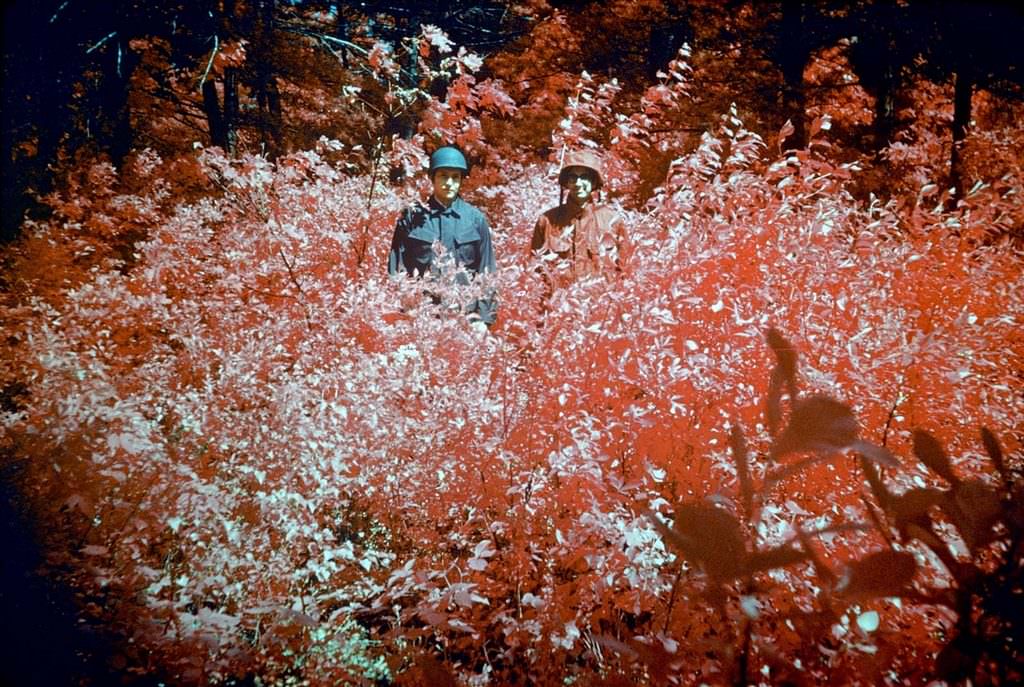
Crimson foliage floods the frame, an otherworldly effect that hints at the science behind the title “Infra-red camouflage, 1974.” Two helmeted figures stand partly swallowed by dense undergrowth, their dark clothing and faces peering through a thicket rendered in hot reds and pale highlights. The unusual color palette isn’t simply artistic—it evokes the way infrared-sensitive film can transform ordinary vegetation into a glowing field, turning the landscape itself into a kind of visual signal.
What makes the scene so compelling is the tension between concealment and exposure. Camouflage traditionally relies on blending into what the human eye expects, but infrared photography and infrared detection ask a different question: how does a body read against living plants when you’re no longer limited to visible light? In this view, leaves and shrubs flare bright while man-made materials hold their own tones, suggesting why inventors and militaries alike experimented with fabrics, dyes, and surface treatments that could better mimic natural infrared reflectance.
From a WordPress storytelling angle, this historical photo sits neatly within the broader history of Cold War-era innovation and surveillance, when new sensors pushed old uniforms to evolve. Readers searching for “infrared camouflage,” “1970s military technology,” or “inventions in photography” will recognize the image as more than a striking color study—it’s evidence of a moment when science altered what could be seen, and therefore what could be hidden. The result is a vivid reminder that every advance in detection tends to spark an equal and opposite advance in disguise.