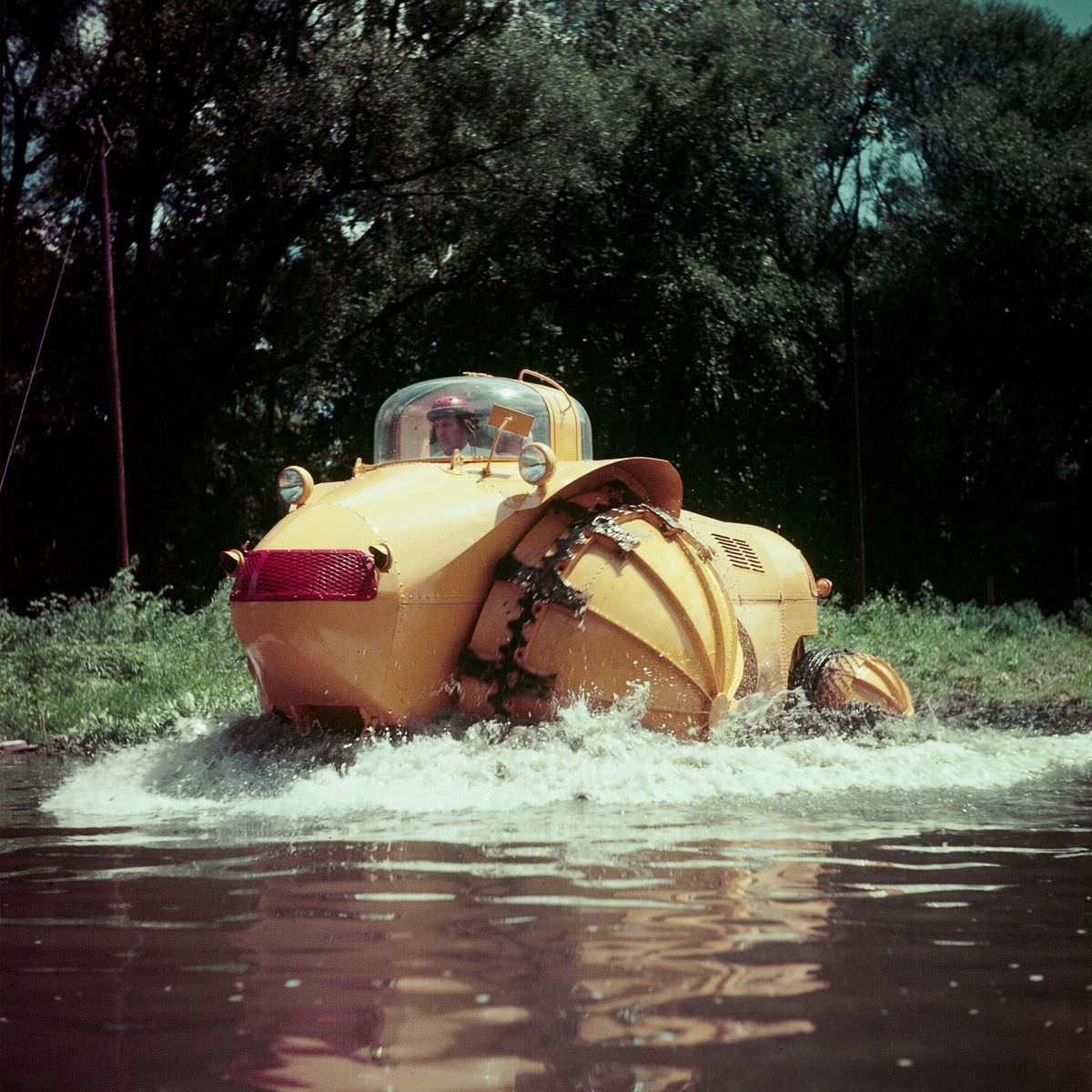
Rolling out of the mid-century imagination, the Rhino 1954 looks less like a car and more like a compact machine built to ignore obstacles. Its rounded body and bubble-like canopy suggest a cockpit rather than a cabin, while the stubby lamps and blunt nose give it an almost amphibious confidence. Even at a glance, the design sells a promise of rugged mobility—an invention meant to keep moving when ordinary vehicles would hesitate.
Water churns around its sides as it pushes forward, revealing the kind of all-terrain ambition that defined many postwar engineering experiments. The broad, protected wheel housings and tightly enclosed form hint at stability, the “unflippable beast” idea captured in metal curves and low-slung mass. Set against a natural backdrop, the Rhino reads as a practical fantasy: a vehicle engineered for mud, shallow crossings, and the unpredictable edge between road and wilderness.
For collectors and curiosity-seekers alike, this historical photo offers a vivid snapshot of 1950s innovation culture, when bold prototypes competed with conventional design. The Rhino’s unusual silhouette makes it perfect for discussions of early off-road concepts, amphibious vehicle history, and the era’s optimism about technology solving terrain itself. If you’re exploring vintage inventions, experimental automobiles, or rare all-terrain machines, this image is a reminder that some of the most interesting ideas were the ones that looked slightly impossible.