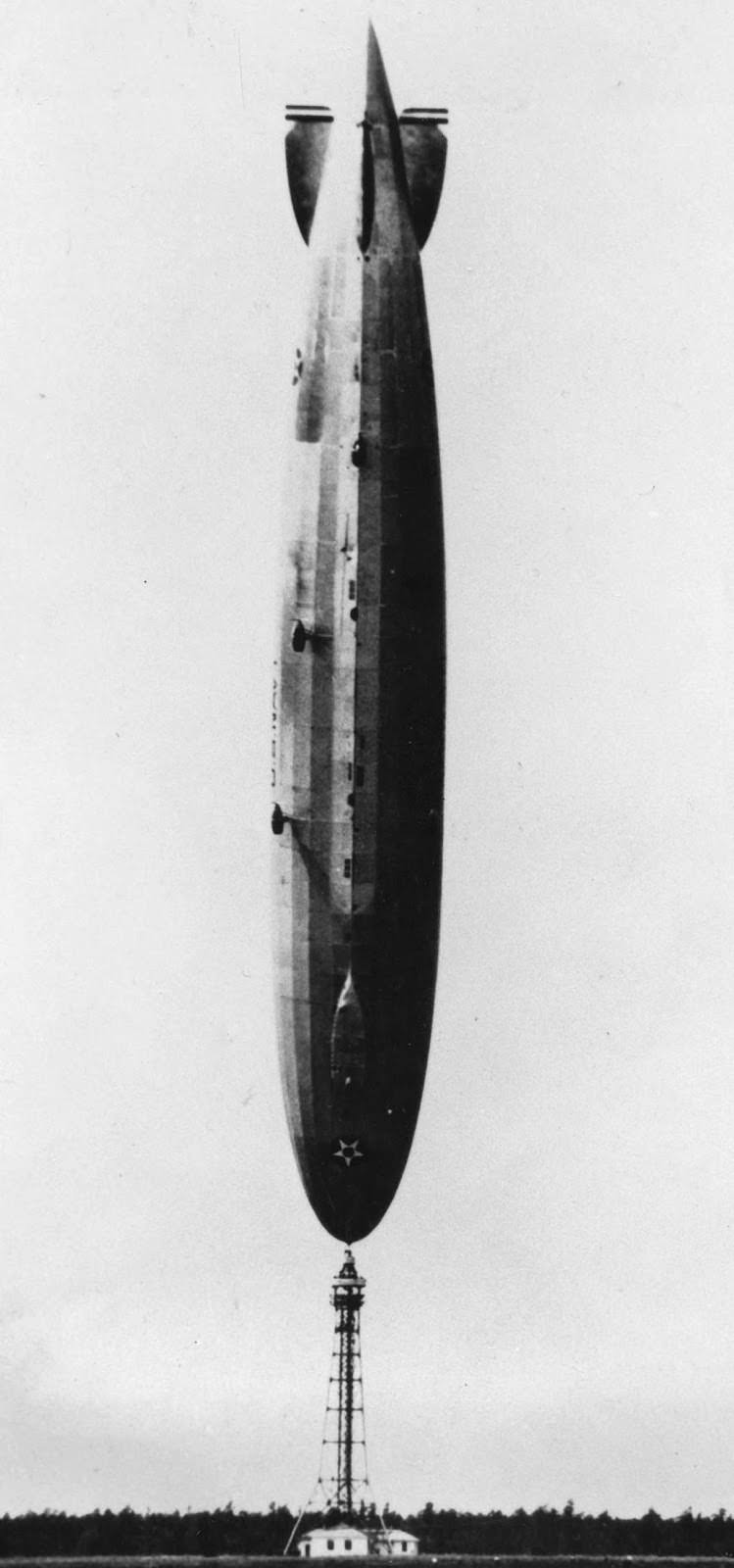
Rising like a needle into an empty sky, the U.S. Navy’s dirigible *Los Angeles* appears improbably vertical, its long hull balanced on its nose above the slender mooring mast at Lakehurst, New Jersey. The airship’s silhouette dominates the frame, with engine cars and fins reduced to small protrusions against the pale background. Below, the ground structures and treeline are tiny, emphasizing just how vast a 700-foot rigid airship could seem when weather and engineering met at the wrong moment.
The title points to the culprit: a turbulent Atlantic wind that flipped the craft during handling in 1926, turning a routine operation into a dramatic spectacle of early aviation. Lakehurst was synonymous with U.S. Navy lighter-than-air work, and photographs like this became visual shorthand for the risks of managing these giants on the ground. Even without visible crowds, the scene suggests the tension of crews wrestling with lines and procedures as forces far larger than any individual tugged at the ship.
As a piece of inventions-era history, the image captures both confidence and vulnerability—an advanced machine rendered nearly weightless, yet at the mercy of gusts and buoyancy. For readers searching aviation history, naval airships, or the story of the dirigible *Los Angeles*, this moment offers an unforgettable angle on how rigid airships were moored, maneuvered, and occasionally humbled. It’s a reminder that progress often arrives with breathtaking feats—and equally breathtaking near-misses.