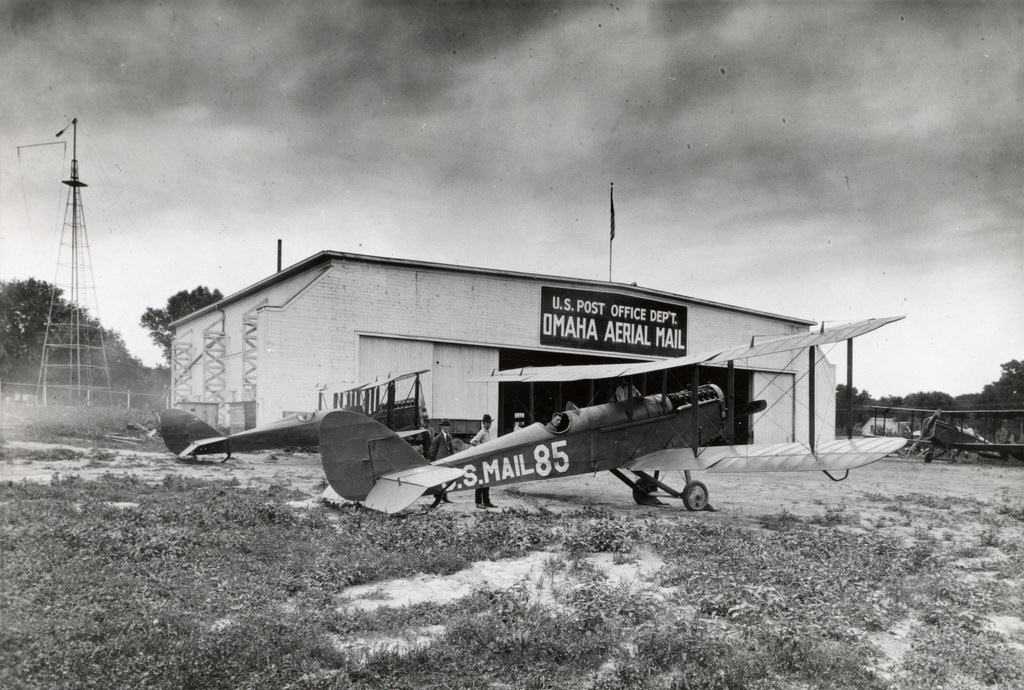
Out on the field at Omaha, Nebraska, an airmail biplane rests in front of a plain but purposeful hangar marked “U.S. Post Office Dept. Omaha Aerial Mail,” a sign that speaks to how quickly aviation became a public service as well as a spectacle. The aircraft’s bold “U.S. MAIL” lettering and large number on the fuselage turn the machine itself into a moving emblem of reliability, meant to be recognized at a glance. Even in stillness, the scene feels busy—an air route not as romance, but as routine.
In 1927, airmail was one of the great proving grounds of invention, pushing engines, airframes, navigation, and ground organization toward something dependable enough for daily schedules. The wide hangar doors, the sparse equipment on the grassy apron, and the long wings poised for another departure hint at the infrastructure required to move letters faster than rail. It’s a reminder that the “modern” world was built not only by daring pilots, but by systems: maintenance, logistics, weather watching, and disciplined timetables.
Details like the open cockpit, spoked wheels, and fabric-covered wings place the viewer firmly in early aviation’s transitional era, when airplanes were becoming tools of commerce and communication. Omaha’s role here connects the Midwest to a broader national network, showing how local airfields helped stitch together distant cities through postal routes. For anyone exploring Nebraska history, the U.S. Post Office’s airmail program, or the evolution of aviation technology, this photograph offers a crisp window into the working landscape of American flight.