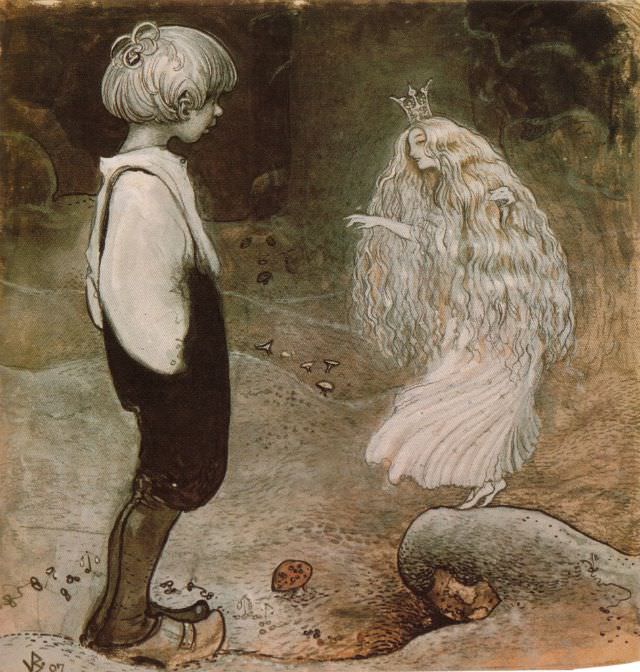
A quiet exchange unfolds in “The Seven Wishes, 1907,” where a young boy stands at the edge of an enchanted clearing, facing a small crowned figure draped in flowing, seaweed-like hair. The boy’s simple clothing and bowed posture suggest hesitation or reverence, while the crowned being’s lifted hand—poised between blessing and instruction—pulls the scene toward folklore rather than everyday life. Muted earth tones and delicate linework give the moment a dreamlike softness, as if we’ve stepped into a story mid-sentence.
Details on the ground reward a slower look: tiny mushrooms dot the path, a rounded stone sits near their feet, and scattered plants curl along the margins like quiet witnesses. The setting feels simultaneously wild and theatrical, with shadowy forms behind them that hint at trees, smoke, or a stage backdrop—just enough uncertainty to keep the imagination working. That blend of the ordinary (a child’s sturdy shoes) with the otherworldly (a diminutive crowned spirit) captures the early-1900s appetite for fairy tales and symbolist fantasy in illustration.
The title invites interpretation, turning this meeting into a meditation on desire—what is asked, what is granted, and what it costs to choose. Whether the “seven wishes” are promises, tests, or temptations, the artwork holds its tension in body language: the boy listens, the crowned figure gestures, and the air between them seems charged with possibility. Ideal for readers searching for 1907 art, vintage fairy-tale illustration, or classic fantasy imagery, this piece offers a timeless doorway into wonder and moral fable.