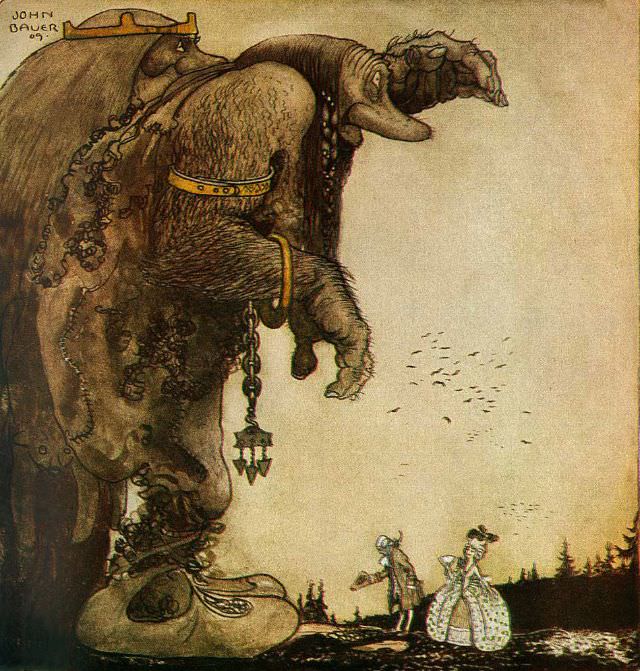
Looming against a pale sky, a crowned giant bends forward as if he has just noticed the tiny figures at his feet. The artist revels in scale: shaggy hair, thick limbs, and oversized shoes rendered with tactile detail, while a delicate, finely dressed pair on the ground turn the scene into a fairytale confrontation. Even the small flock of birds nearby works like a measuring stick, emphasizing how immense and otherworldly the giant appears.
Gilded accessories—chains, a dangling ornament, and the suggestion of regalia—hint at power that is both ceremonial and unsettling. The giant’s posture feels weary rather than triumphant, his head and shoulders drooping under the weight of his own mass, as though kingship has become a burden. In contrast, the smaller characters seem poised between curiosity and caution, their elegant clothing and upright stance evoking the storybook worlds that early 20th-century illustration loved to revisit.
Titled “Giant, 1909,” this artwork sits at the crossroads of folklore and the era’s distinctive graphic sensibilities, with muted color washes and crisp linework shaping an atmosphere of quiet tension. It’s an evocative historical image for readers searching for vintage fantasy art, Edwardian-era illustration, or early 1900s artworks that lean into mythic themes. The composition invites lingering: the vast, textured body above and the fragile human scale below, suspended in a moment just before the tale turns.