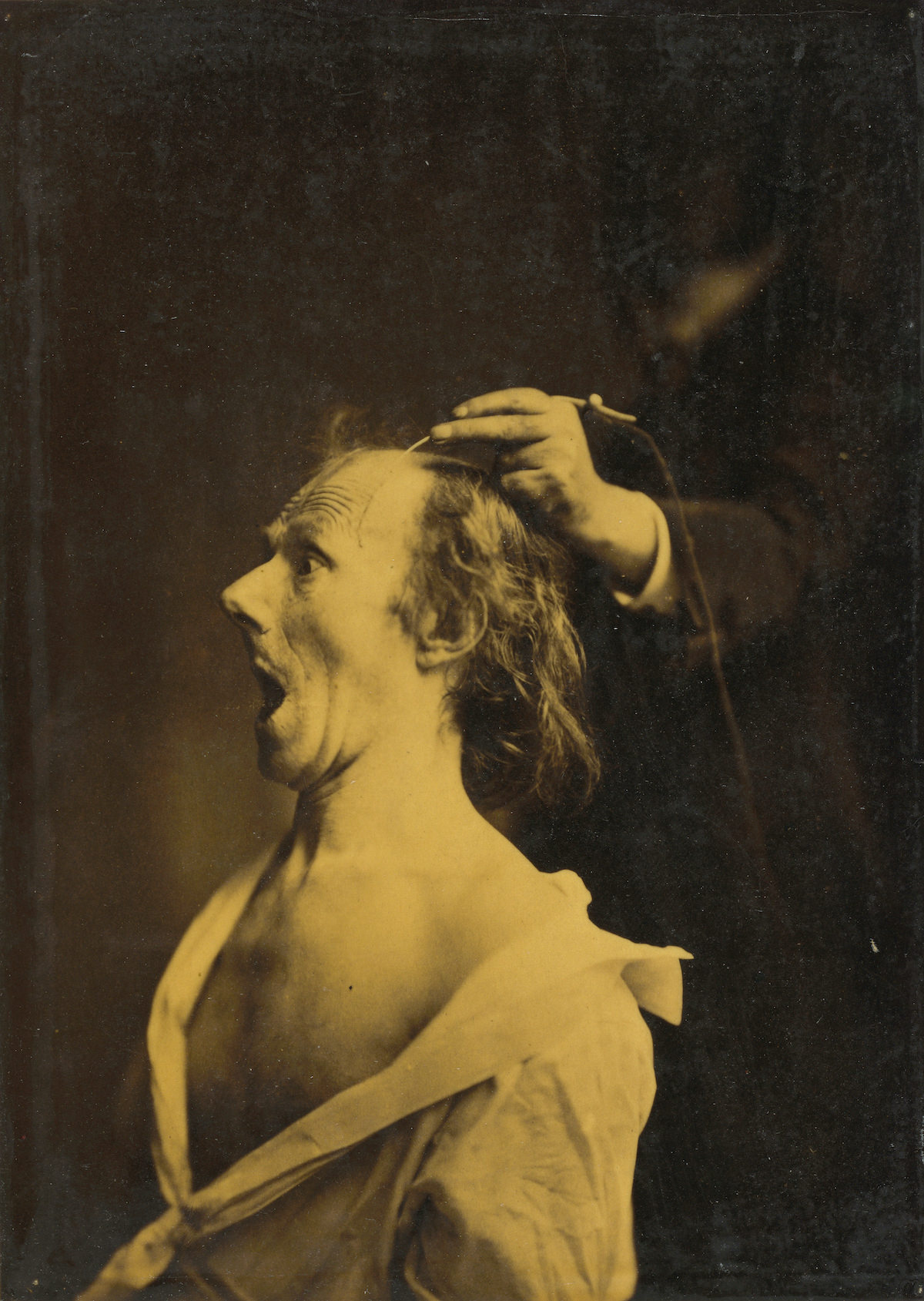
A man recoils with his mouth open in a raw, theatrical gasp, while a second figure hovers behind him, half-lost in shadow. The hand near the scalp—holding a thin instrument and a trailing cord—adds an unsettling, clinical note, as if astonishment has been induced rather than simply felt. Rendered in warm sepia tones with deep, velvety blacks, the scene reads like a staged study of emotion where the body becomes the main language.
The title, “Astonishment, stupefaction, amazement,” fits the moment perfectly: furrowed brow, widened eye, taut neck, and a shirt slipping from the shoulder all amplify the sensation of shock. Whether interpreted as performance, experiment, or artistic provocation, the photograph lingers on the boundary between observation and intrusion. Its dramatic lighting and close framing pull the viewer into a private instant that feels both intimate and uncanny.
As an artwork, this historical photo invites questions about how earlier generations tried to picture the invisible—fear, surprise, disbelief—and how the camera was used to authenticate such fleeting states. The ambiguity is part of its power: we are left to imagine the context, the purpose, and the relationship between sitter and operator. For readers searching for antique photography, early portraiture, and the history of emotion in visual culture, this image offers a striking meditation on what it means to be truly, visibly amazed.