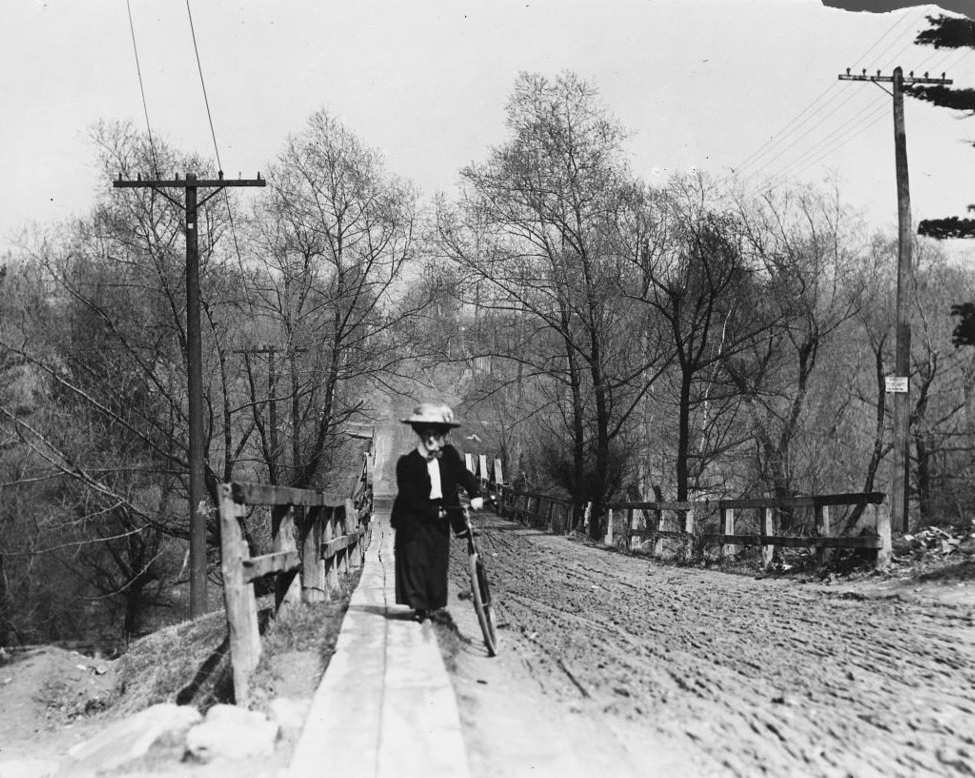
Up a rutted, muddy incline, a lone cyclist in a brimmed hat guides a bicycle by hand, choosing steady footing over speed as the road climbs toward St. Clair. A narrow plank sidewalk runs alongside the grade, hemmed in by rough wooden railings and bare-branched trees that hint at early spring or late autumn. Telegraph poles and overhead lines punctuate the scene, reminding us how quickly modern infrastructure was threading its way through everyday streets in 1907.
The title’s matter-of-fact phrasing—“Walking it up the hill”—says a lot about cycling in early 1900s Toronto, when steep grades and unpaved surfaces routinely turned a ride into a push. Here, the bicycle reads less like a leisure toy and more like practical transport, used despite weathered roads and limited maintenance. Even the empty roadway feels instructive: before automobiles dominated, cyclists and pedestrians negotiated space on streets that were still evolving from country lanes into city arteries.
For readers drawn to historical photos of Toronto cycling, this moment captures the grit behind the romance of the era: the effort of travel, the texture of the landscape, and the slow transformation of neighborhoods at the city’s edge. Details like the simple fencing, the utility lines, and the improvised walkway offer a snapshot of infrastructure in transition, when getting to St. Clair could mean carrying your momentum one step at a time. It’s an unglamorous scene, and that honesty is exactly what makes it such a vivid piece of urban history.