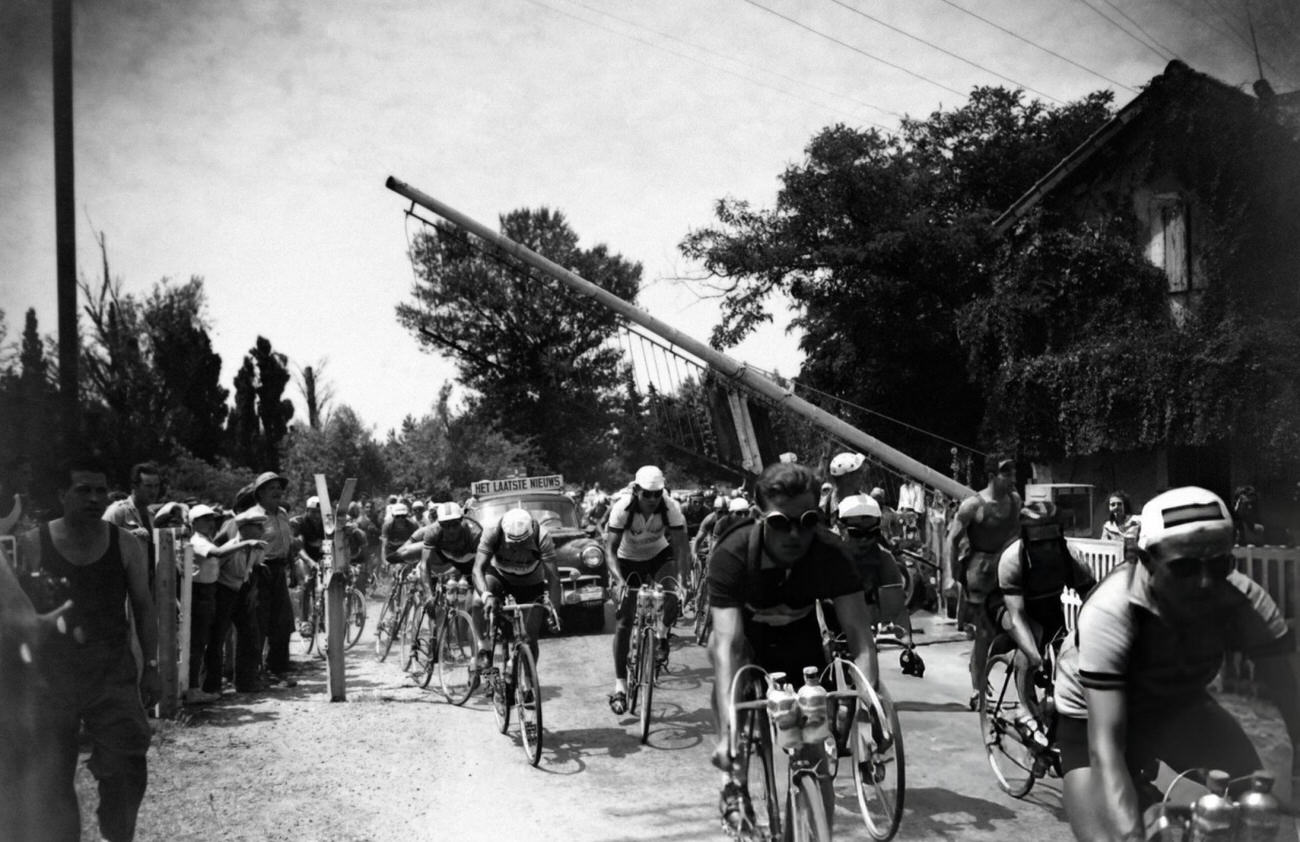
A striped barrier arm hangs diagonally over the road as the Tour de France peloton surges through a railway grade crossing, turning an ordinary pinch point into a moment of pure drama. Riders in close formation lean into their handlebars, faces set with concentration, while a race car and a cluster of officials and helpers trail just behind, hinting at the logistical machine that followed the competitors from town to town.
Along both sides of the narrow lane, spectators press in close—some perched by the fence, others standing in the dust—watching the action pass within arm’s reach. The scene feels unmistakably mid-century: simple road surfaces, minimal crowd control, and overhead lines cutting across the sky, with trees and a farmhouse-like building framing the course as if the race has threaded itself directly through everyday life.
Taken in 1953, this photograph speaks to the Tour’s blend of endurance sport and public spectacle, where speed met infrastructure and timing mattered as much as strength. The grade crossing is more than background; it’s a reminder that the route crossed working rail lines and rural byways, demanding attention from riders and cooperation from local communities. For anyone exploring Tour de France history, classic cycling photography, or the atmosphere of postwar European sport, this image delivers texture, tension, and a strong sense of place.