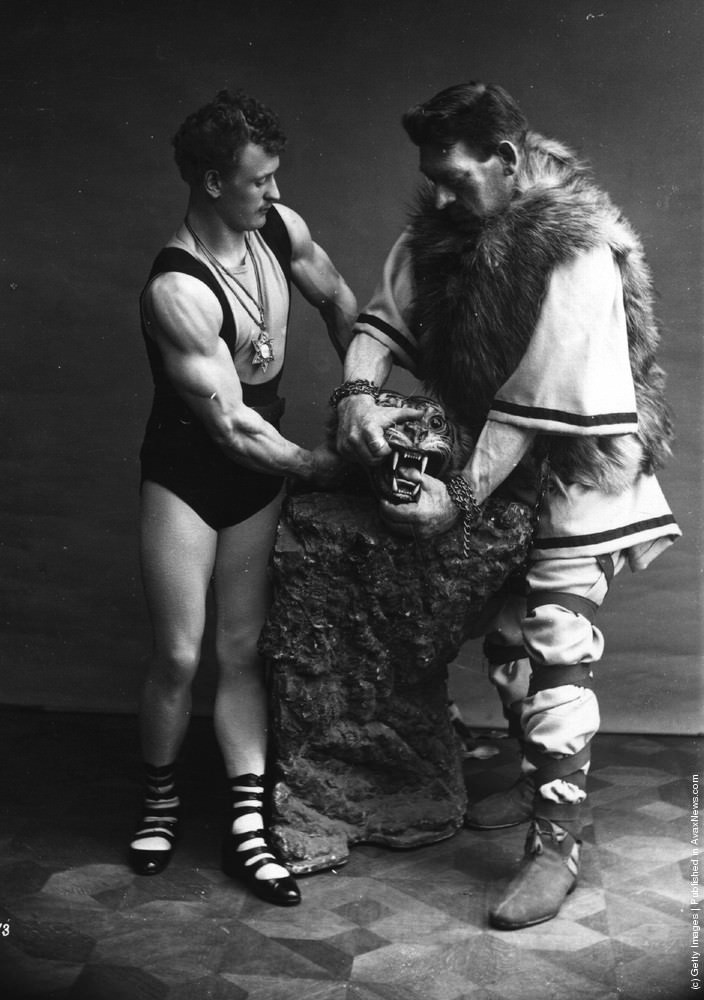
Eugene Sandow and Goliath pose in a staged struggle that leans hard into the early-1900s taste for spectacle, where strength was marketed as both entertainment and ideal. One man stands in a tight athletic outfit that turns the body into a display of sculpted muscle, while the other wears a fur-trimmed costume that evokes the “wild” frontier. Between them, a bear—restrained with chains—becomes the dramatic centerpiece, its open jaws and lowered head arranged to heighten the sense of danger.
The scene reads like a promotional still for vaudeville or circus-style strongman acts, when posters and photographs helped sell a night’s thrill as much as the performance itself. Sandow’s calm focus contrasts with the animal’s forced ferocity, a visual pairing meant to reassure viewers that human discipline could master nature’s raw power. Even the studio backdrop and controlled lighting emphasize choreography over chaos, hinting that what audiences were buying was a carefully crafted illusion of risk.
As a 1910 sports and entertainment artifact, the image offers a window into the origins of modern bodybuilding celebrity and the era’s fascination with “man versus beast” narratives. It also reflects period attitudes toward animal acts, where captivity and restraint were treated as props rather than ethical questions. For readers searching strongman history, Eugene Sandow photos, or early wrestling spectacle, this photograph stands as a vivid reminder of how physical culture was performed, photographed, and sold to the public.