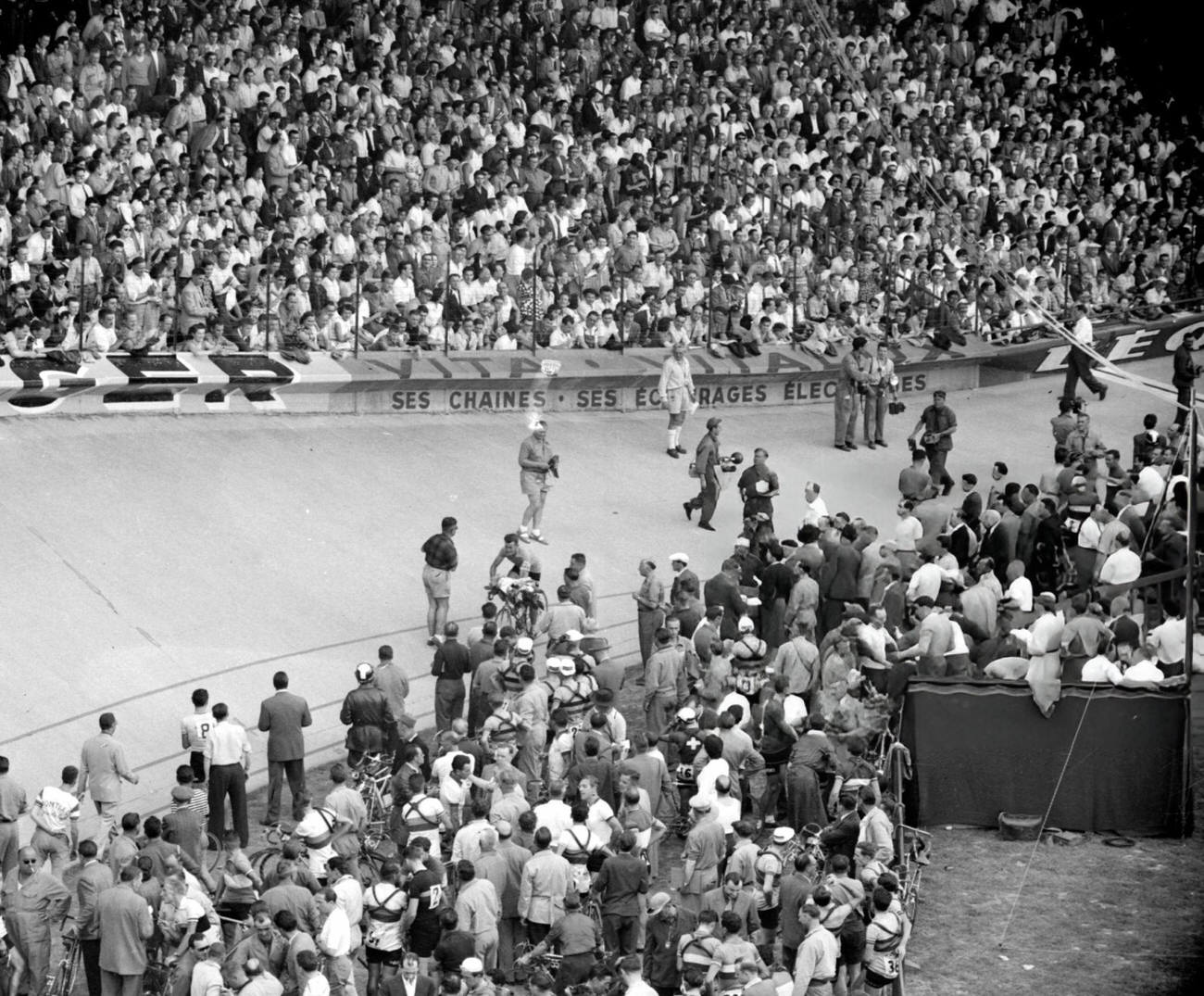
Packed grandstands press in on the final scene of the 1953 Tour de France, as Louison Bobet completes his lap of honor with the calm, spent posture of a champion who has already done the hardest work. The track below is crowded with officials, photographers, and support staff, all converging toward the rider and his machine while the spectators lean forward, eager for a last look. Advertising boards and stadium railings frame the moment, grounding this victory not in myth but in the bustling reality of postwar European sport.
Bobet’s win reads here as a public ritual as much as an athletic feat: the ceremonial circuit that turns endurance into celebration, and personal triumph into a shared memory. Cameras are poised at different angles, suggesting the growing importance of media in cycling’s golden age, when newsreels and press photos carried the Tour’s drama far beyond the finish line. Even without a close-up, the image conveys the emotional tempo of the finale—applause above, purposeful movement below, and one rider at the center of it all.
For collectors and historians of cycling photography, this is a rich snapshot of Tour de France culture in the early 1950s, capturing the spectacle of victory alongside the machinery that documented it. Details like the density of the crowd, the orderly chaos on the infield, and the stark geometry of the track help tell the story of how big races were staged and witnessed in that era. Whether you arrive searching for Louison Bobet, the 1953 Tour de France, or classic sports history, the scene offers a vivid doorway into a landmark finish.