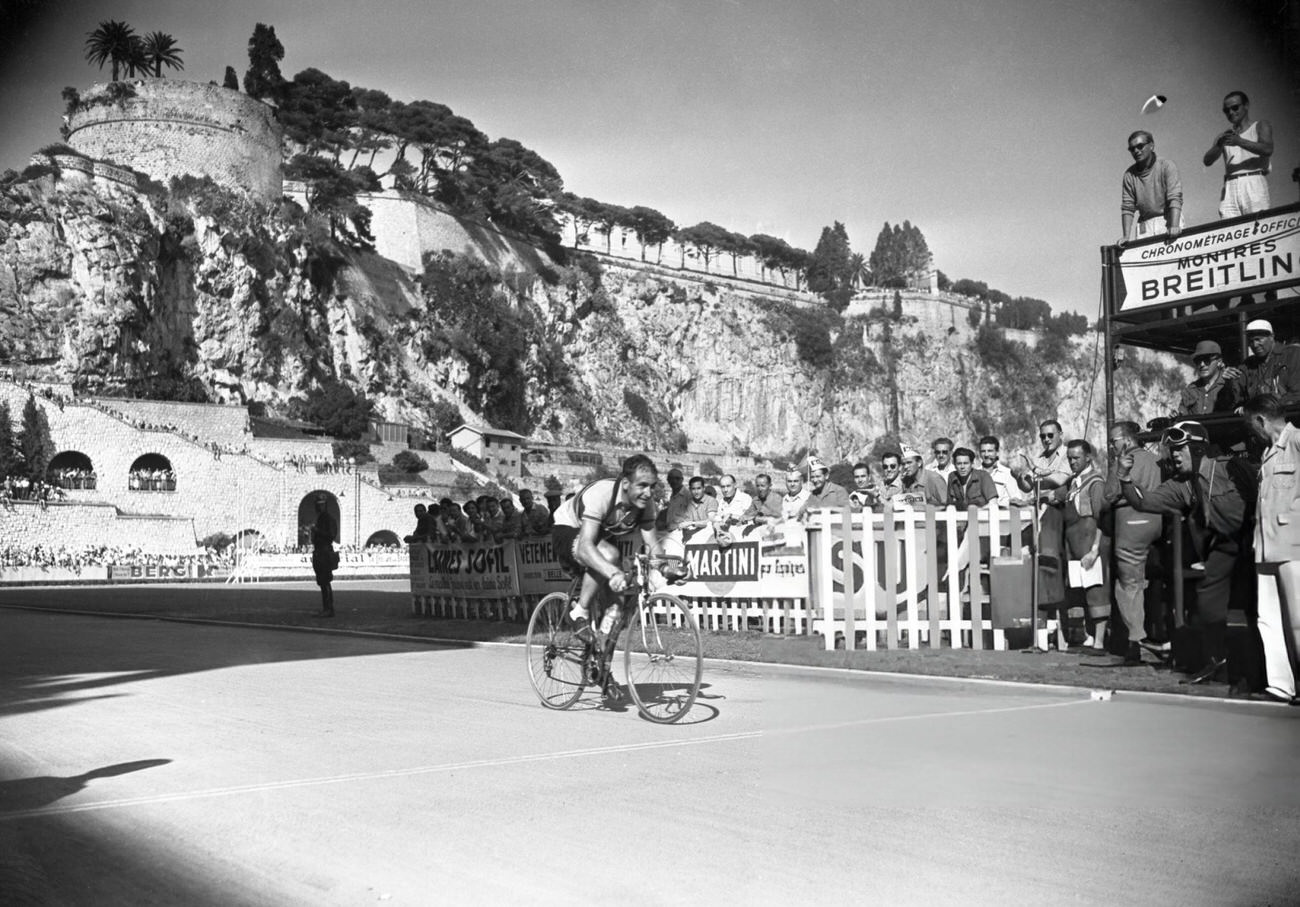
Wim van Est drives his bicycle toward the line with a hard, forward-leaning sprint, the kind of effort that turns a long day on the road into a single decisive moment. The title places this finish on the Marseille–Monaco stage of the 1953 Tour de France, and the scene matches the drama: spectators crowd behind barriers, officials watch from a raised timing stand, and the rider’s focus narrows to the final meters.
Behind the action, steep rocky cliffs and a sunlit Mediterranean backdrop frame the road like a natural amphitheater, reminding us how strongly the Tour de France is shaped by landscape as much as by rivals. Advertisements on boards and banners—classic period branding that once defined cycling’s roadside theater—add texture and authenticity, anchoring the photograph in the commercial and sporting culture of the early 1950s.
What lingers is the contrast between intimacy and spectacle: one cyclist alone in the foreground, yet surrounded by an entire apparatus of clocks, cameras, marshals, and fans. For readers searching for Tour de France history, Wim van Est, or iconic finishes on the road to Monaco, this image offers a vivid snapshot of postwar European sport—where endurance, tactics, and a final burst of speed converge in front of an eager crowd.