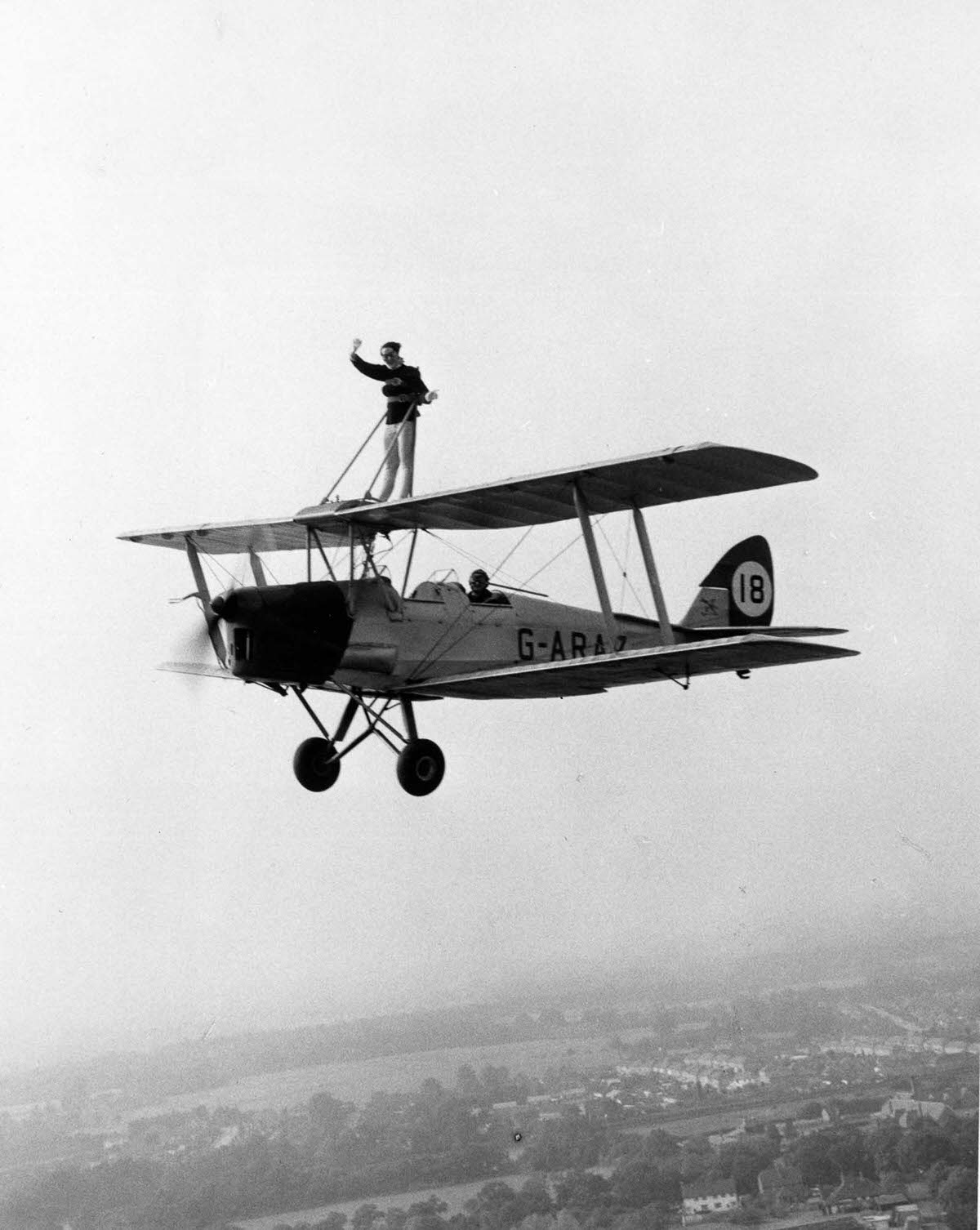
High above a patchwork of rooftops and fields, Juanita Jover stands upright on the top wing of a Tiger Moth biplane, one arm lifted in a casual wave that belies the wind and the drop below. Straps and lines tether her to the aircraft’s rigging, turning an open-air flight into a tightrope act performed in the sky. In the cockpit beneath her, stunt pilot Lewis Benjamin keeps the little biplane steady while the classic silhouette—two wings, exposed struts, and a spinning prop—cuts through the pale haze.
Wing walking was never just a moment of bravado; it was choreography, engineering, and nerve working in unison. The photo invites a closer look at the aircraft’s framework and the performer’s stance, where balance and body position mattered as much as the harness. That contrast—an intimate human figure perched on a machine built for motion—helps explain why air show stunts fascinated crowds long after early aviation’s pioneering days had passed.
Dated 1962 in the title, this scene speaks to a mid-century appetite for spectacle, when aerobatics and daredevil routines still carried the glamour of barnstorming tradition. For aviation history fans, the Tiger Moth alone is a compelling subject, a training biplane that became an enduring star of display flying; paired with a wing-walking performance, it becomes a vivid snapshot of risk, romance, and showmanship. As a historical photo, it captures the thin line between entertainment and danger, preserved in a single, breath-holding frame.