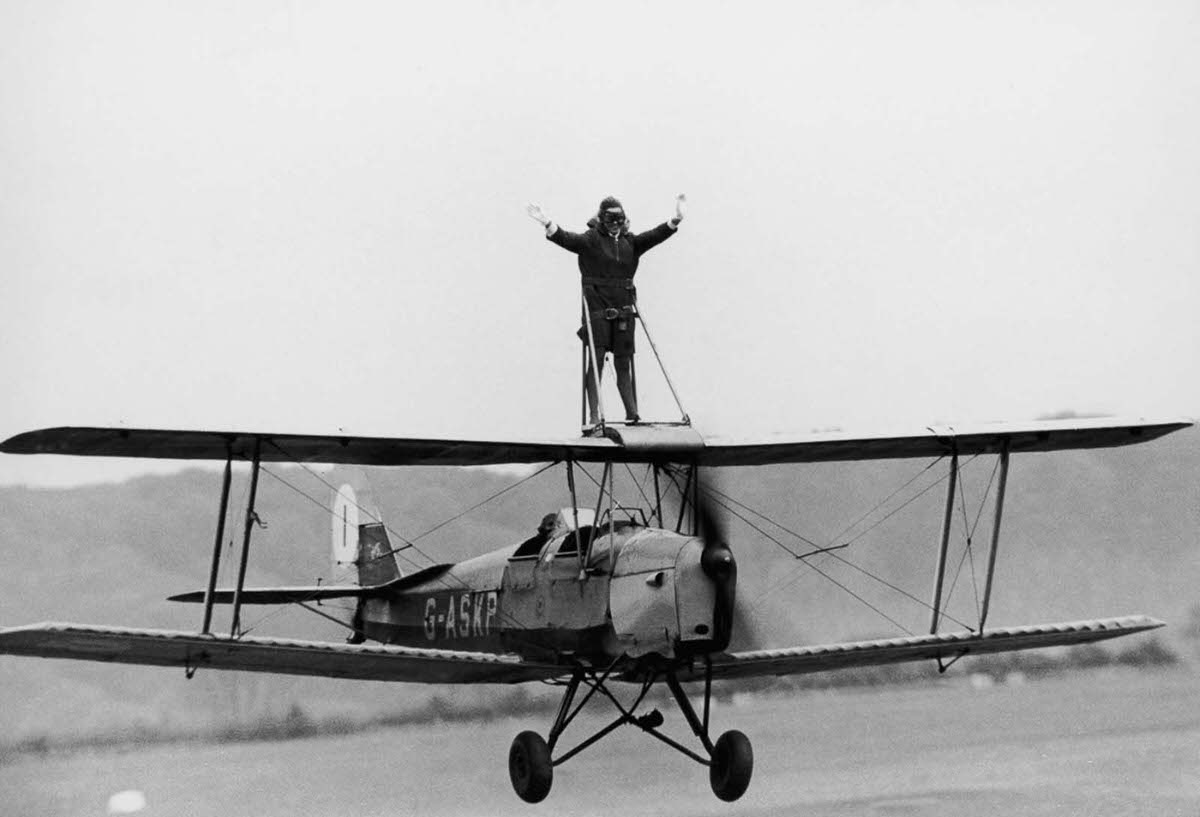
High above the runway at Wycombe Air Park in Buckinghamshire, a Tiger Moth biplane cuts through open sky with a wing-walker standing upright on the top wing, arms raised in a showman’s salute. The aircraft’s braced struts and web of rigging wires frame the figure like a stage, while the blurred propeller and distant landscape remind you that this is no static pose—it’s a performance conducted at full speed and altitude. Captured in 1968, the scene carries the crisp drama of classic air display photography, where daring and precision meet in a single instant.
Jacqui Cheesman’s wing-walking act echoes the earliest days of aviation, when barnstorming pilots and aerial entertainers helped turn flying into mass spectacle. Even in an era increasingly dominated by jets and modern airfields, the Tiger Moth—already a beloved training aircraft and symbol of interwar flying—remained perfectly suited to this older, more intimate kind of aerial theatre. The contrast is part of the fascination: 1960s Britain looking upward, and finding excitement not only in new technology but also in living traditions that refused to fade.
Details in the photograph underline how much skill lies behind the apparent bravado: the secure stance, the streamlined clothing, and the purposeful posture designed to read clearly to spectators on the ground. For readers interested in wing walking, the de Havilland Tiger Moth, or British airshows at Wycombe Air Park, this image offers a vivid doorway into the culture of aviation sport and stunt flying. It’s a reminder that the history of flight is not just machines and milestones, but performers and crowds—moments when courage was part of the choreography.