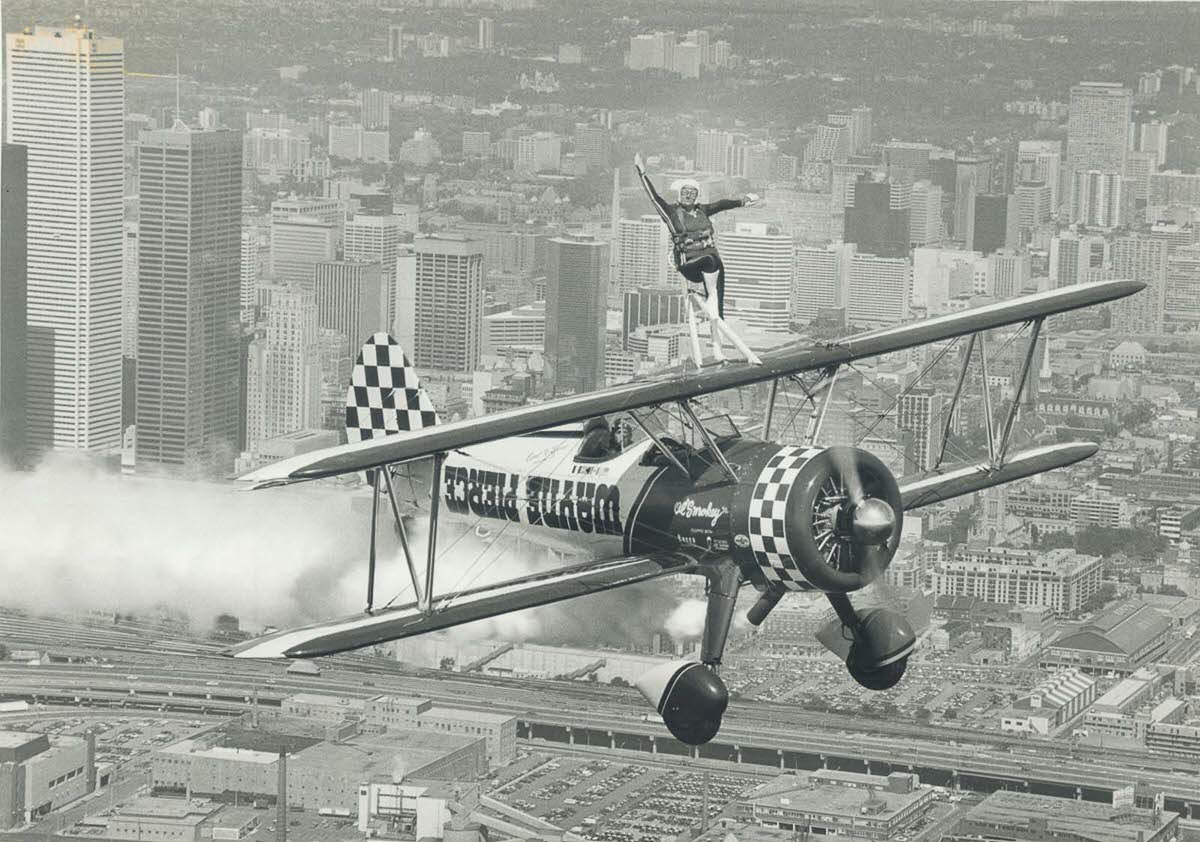
High above Toronto’s dense grid of towers and streets, Carol Lynne stands atop the upper wing of a biplane, arms lifted as if balancing on the very edge of the sky. The aircraft’s checkerboard markings and the bold “Stardust” lettering give the scene a showman’s flair, while a trailing plume of smoke sketches a bright line through the air. In the foreground, the radial engine and struts frame a startling contrast: hard city geometry below, human daring above.
Wing walking is often remembered as a headline-grabbing stunt from aviation’s early decades, yet the title places this performance in 1982—proof that the appetite for barnstorming spectacle never fully vanished. Lynne’s poised stance suggests practiced control rather than chaos, and the biplane’s open, mechanical look evokes an earlier era of flight even as it sweeps over a modern skyline. The image captures that uneasy marriage of precision and risk that defines airshow culture: choreography performed in moving wind.
For readers drawn to aviation history, daredevil sports, and Toronto’s changing cityscape, this photograph delivers a rare intersection of all three. It also hints at the partnership behind the feat, noting that the biplane was piloted by her husband—an airborne trust exercise as much as a public performance. Whether you arrive here searching for “wing walking,” “biplane airshow,” or “Toronto 1982,” the moment lingers as a reminder that some traditions survive because they still make us look up.