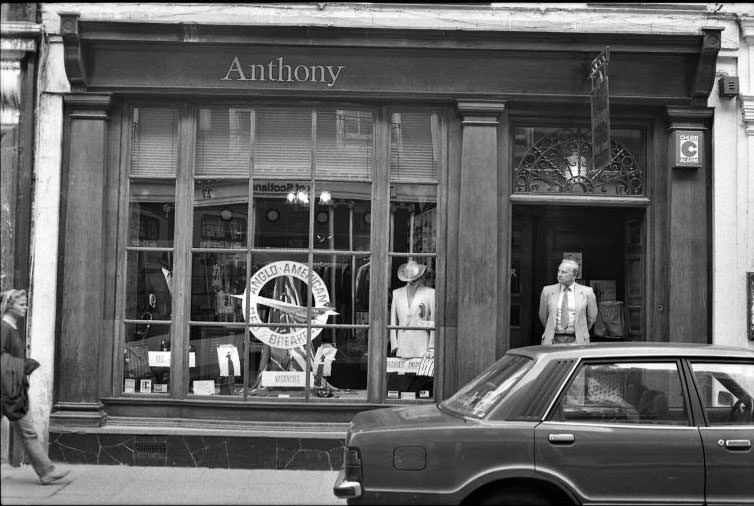
Along Trinity Street, the shopfront of “Anthony” makes a confident statement in glass and timber, with tall display windows framed by stout pilasters and a deep fascia sign that reads cleanly above the street. Inside the window, mannequins and neatly arranged menswear hint at the promise of a proper gentleman’s outfitters—tailored lines, polished accessories, and the quiet discipline of a well-kept wardrobe. The composition draws the eye from the orderly merchandise to the architectural details, suggesting a retailer that traded as much on presentation as on cloth.
A large circular sign in the window advertising “Anglo-American” adds another layer to the scene, placing this business within a wider commercial world of brands and suppliers. Reflections on the glass mingle with the interior displays, giving the photograph that distinctive high-street texture where passers-by, products, and street life overlap. Even without a stated date, the storefront design and window dressing evoke a period when shopping was as much about browsing and aspiration as it was about purchase.
At the right-hand entrance, a man pauses in the doorway, while a parked car occupies the foreground—small, everyday details that anchor the image in the routines of Trinity Street. The result is a rich slice of urban retail history: a menswear shop, its signage and window displays, and the surrounding street scene all preserved in a single frame. For readers interested in local heritage, historic shopfronts, or the evolution of men’s fashion retail, this photo offers plenty to linger over.