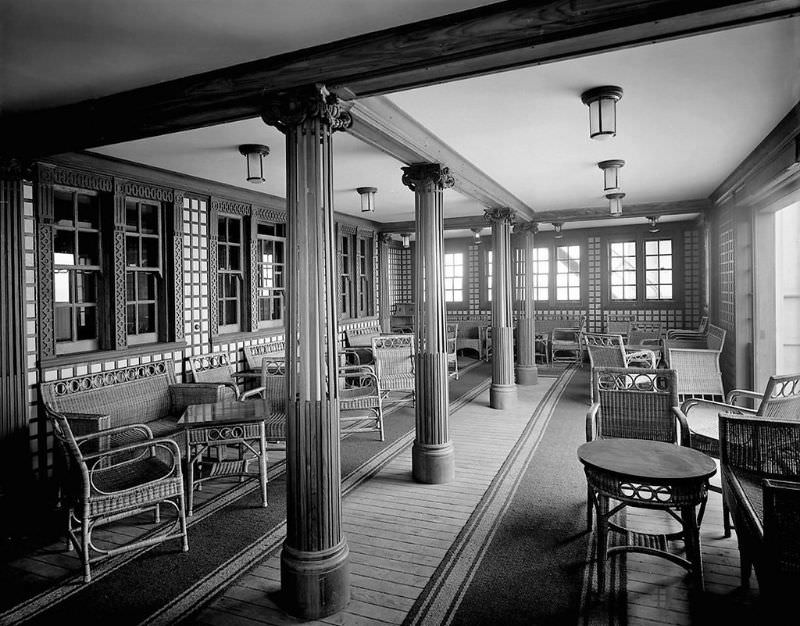
Stepping onto Aquitania’s Bridge Deck (B Deck) in May 1914, the 2nd Class Verandah Café reads like a carefully staged promise of comfort at sea. Rows of wicker chairs and small tables line a long, sheltered passage, while stout columns and patterned wall panels give the space a dignified, almost club-like feel. The view looks across to the starboard side, where open sliding doors invite light and air to spill into the room.
Details do much of the storytelling here: the rhythmic ceiling lamps, the tidy floor runners, and the repeating window grids that make the café feel both airy and ordered. Even without passengers present, you can imagine the everyday rituals of an Atlantic crossing—quiet conversation, cups set down on tabletops, and the soft boundary between indoor warmth and the breezier verandah beyond. It’s a revealing look at how a great ocean liner made “second class” mean something closer to respectable leisure than mere transport.
For readers drawn to maritime history and Edwardian travel, this photograph offers a sharp reminder that design was an invention in its own right. Aquitania’s public rooms were engineered for movement, weather, and social life, using sliding doors and sheltered seating to turn the Bridge Deck into a flexible promenade space. As an SEO-friendly window into Aquitania interiors, second-class amenities, and early 20th-century ocean liner culture, this verandah café scene captures the architecture of comfort just before the world changed.