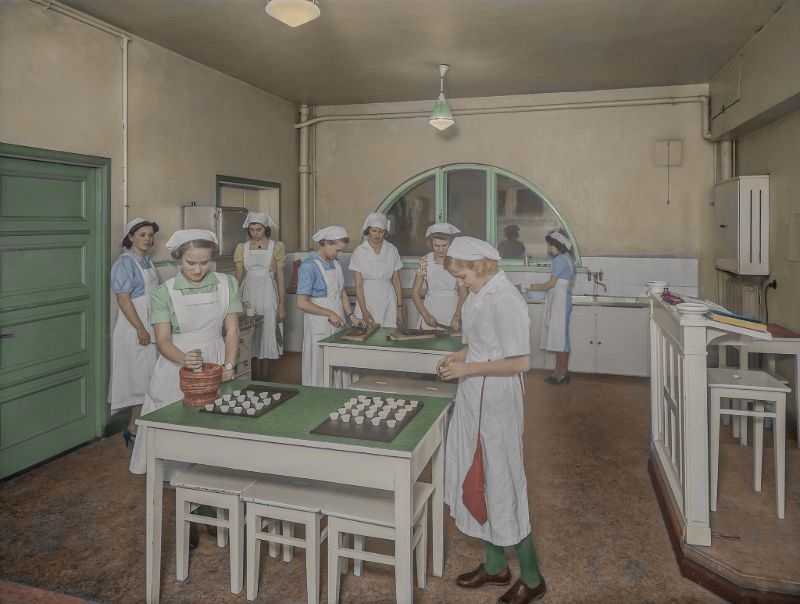
Aprons tied and caps neatly in place, a group of students from Privata Svenska Flickskolan in Finland gathers around sturdy worktables for a cooking lesson in the 1930s. The colorized scene brings out the calm order of the room: green-painted doors and tabletops, pale walls, and bright white uniforms that emphasize cleanliness and discipline. Trays of small portions are lined up with care, while a mortar and pestle and other simple tools suggest hands-on instruction rather than mere demonstration.
At the center, the girls work in pairs and small clusters, measuring, mixing, and watching one another’s technique as if following a practiced routine. A larger prep counter and sink area along the back wall hint at a well-equipped school kitchen designed for teaching, not just serving. Even without a visible teacher in frame, the posture and spacing—each student at a task, each station kept tidy—reflect the structured domestic science education common in many European schools of the era.
Beyond its charm, this historical photo offers a window into Swedish-language schooling in Finland and the everyday curriculum that shaped young women’s lives between the wars. Cooking lessons like this blended practical skills with modern ideas about hygiene, nutrition, and household management, all within an institutional setting. For readers interested in 1930s school life, Finnish history, and the material culture of education, this colorization helps the period feel immediate and surprisingly familiar.