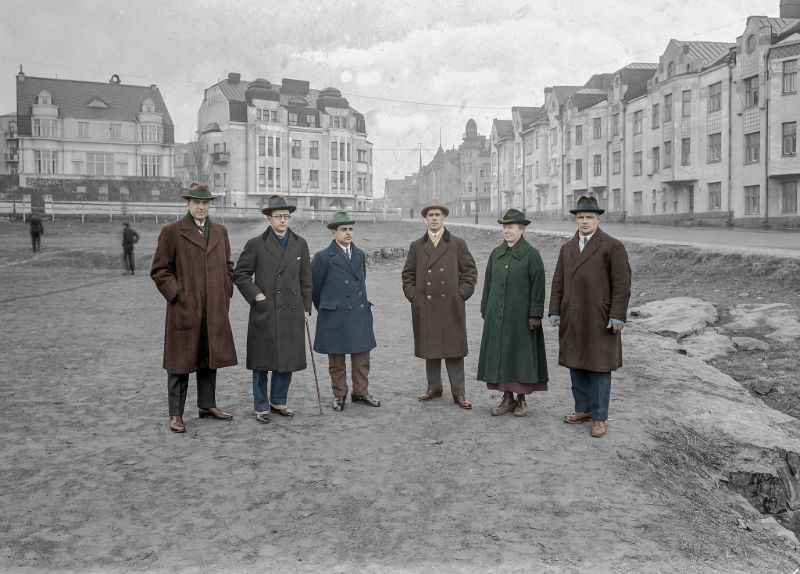
Against a wide, unpaved expanse, several bundled-up figures stand in a loose line as if weighing a decision that will outlast the day’s cold. Their long coats and brimmed hats give the scene a formal, municipal air, while the open ground at their feet suggests a city still being shaped. Behind them, rows of apartment buildings and storefronts frame the space, turning what looks like an empty lot into a future address in everyday Helsinki life.
The title identifies them as the Sports Committee of the city of Helsinki, inspecting a potential site for a children’s playground in 1923, and that context makes the moment feel quietly consequential. There’s no ribbon-cutting yet—only planning, surveying, and the practical work of imagining swings and sand where there is currently bare earth and rough edges. Even without hearing their conversation, you can sense the early 20th-century push to provide organized recreation and safer outdoor spaces for children as the city modernized.
Colorization adds an immediacy that pulls the scene out of the archive and into the present, emphasizing the contrast between dark overcoats and the pale, open street. Details in the surrounding façades and the muted tones of the ground help readers picture what “urban development” looked like before the playground existed, when decisions were made on site and in person. For anyone interested in Helsinki history, public planning, or the roots of children’s play spaces, this photograph offers a rare, grounded glimpse of civic life in the 1920s.