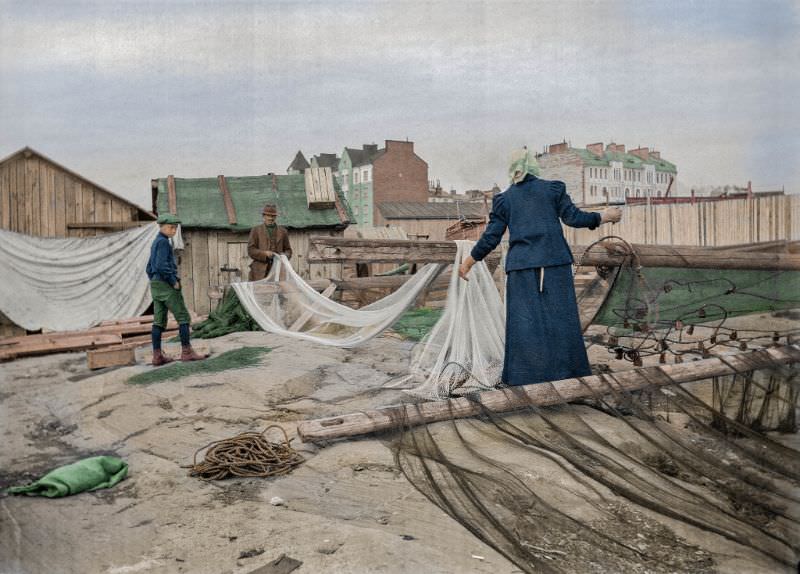
Along Helsinki’s waterfront in the 1910s, the day’s real work often began after the boats were ashore. Nets are hauled up onto rough wooden frames and spread wide like gauze, their fine mesh catching the light while hands check for snags, tears, and twisted lines. The colorization brings out the salty palette of working clothes, weathered timber, and sea-worn rope, turning a practical routine into a vivid street-level scene.
In the foreground, coils of line and dark netting lie heavy across the ground, while a small group tends to the lighter sections with practiced care. Drying mattered, but so did maintenance: a damp, poorly stored net could rot, and a missed hole could cost a day’s catch. The simple sheds and makeshift racks suggest an outdoor workshop where skill, patience, and repetition kept the fishing economy running.
Beyond the nets, the low skyline hints at a city growing up alongside its harbor, with everyday labor unfolding against rows of buildings. Moments like this—quiet, unsentimental, and intensely physical—help anchor Helsinki’s maritime history in human scale. For readers interested in Finnish coastal life, traditional fishing, or early twentieth-century urban waterfronts, the scene offers a textured glimpse of how livelihoods were literally mended strand by strand.