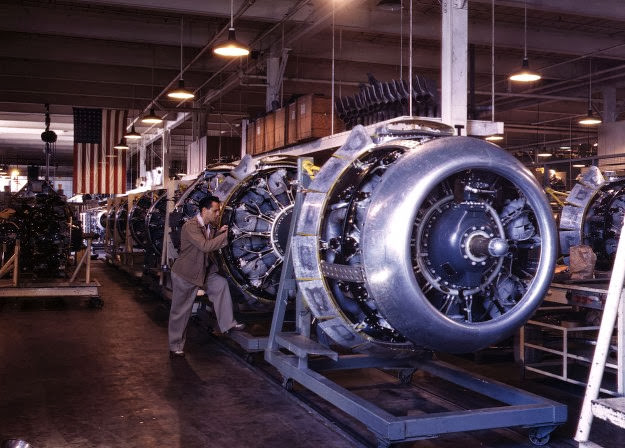
Along a factory aisle at North American Aviation in Inglewood, rows of B-25 bomber engines sit cradled on heavy metal stands, their radial cylinders and wiring laid bare under bright shop lights. A worker leans in close to the nearest powerplant, the kind of careful, hands-on attention that defined wartime aircraft production as components moved steadily from station to station. Overhead, the high ceiling, hanging lamps, and an American flag anchor the scene in the disciplined rhythm of an industrial floor built for speed and consistency.
Cowling and control rods—the practical hardware that helps shape airflow and translate cockpit inputs into engine behavior—are the focus here, and the photograph emphasizes how much precision lived beneath a bomber’s skin. The circular cowling ring and the dense geometry of fasteners, linkages, and housings highlight the engineered complexity of a B-25 motor before it ever met a wing. Even without seeing the full aircraft, the assembly line arrangement suggests a larger pipeline: standardized parts, repeatable processes, and skilled labor converging to keep bombers rolling out in quantity.
In colorized form, the image gains an immediacy that makes the factory environment feel less distant, from the cool sheen of metal to the warm pools of light on the concrete floor. For readers interested in World War II aviation history, North American Aviation, or the B-25 Mitchell’s production story, this moment offers a grounded look at how bomber performance began with meticulous assembly work. It’s a reminder that airpower was built as much by mechanics and manufacturing systems as by the crews who later flew these machines into combat.