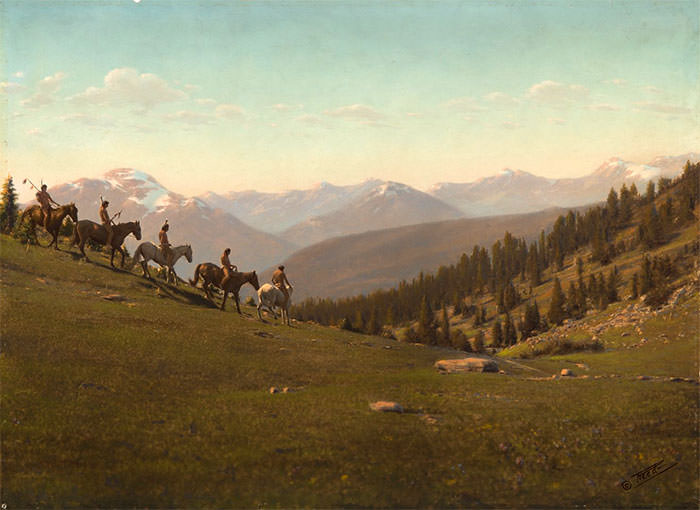
Five riders angle their horses down a sunlit hillside, their silhouettes stepping lightly against the broad sweep of Montana’s high country. The handpainted color gives the scene an almost postcard warmth—soft greens in the foreground, a pale blue sky, and distant mountain ridges fading into atmospheric haze. It’s a simple composition with a strong sense of motion, as if the viewer has paused on the slope just long enough to watch the group descend.
Roland W. Reed’s lens (and the later colorization) emphasizes scale: people and animals become a rhythmic line set against enormous valleys and snow-dusted peaks. The riders’ upright posture and the horses’ careful footing suggest practiced travel over uneven ground rather than a staged parade. In the early 1900s, images like this helped shape how the American West was imagined—open, elevated, and defined by movement through vast landscapes.
Handpainted prints occupy a fascinating middle ground between photograph and artwork, adding interpretive color to a moment originally recorded in monochrome. Here, the technique highlights seasonal light and terrain texture, inviting modern viewers to linger over details—the scattered rocks, the treeline climbing the opposite ridge, and the way the land falls away toward the mountains. For anyone searching for early 20th-century Montana photography, Western riders on horseback, or vintage colorized prints, this piece offers a vivid window into the era’s visual storytelling.