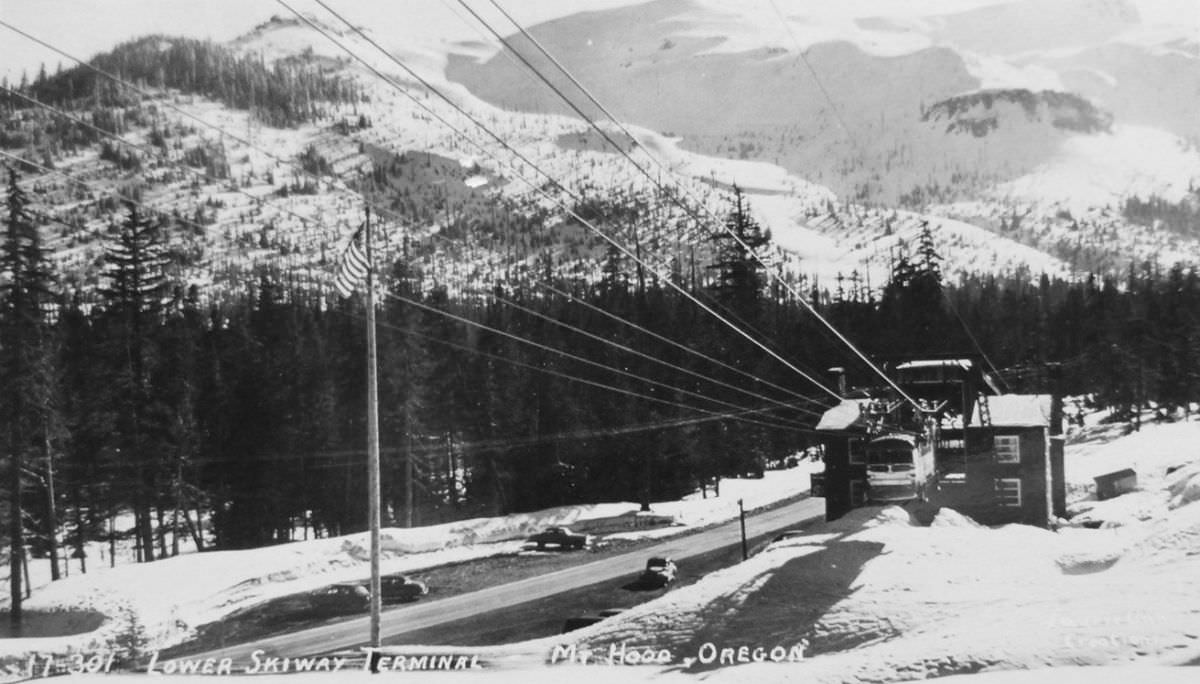
Snowy slopes and dark stands of evergreen frame the busy lower end of a ski tramway at Timberline Lodge, with cables fanning out overhead toward the mountain. An American flag flutters beside the road where a few cars sit against the snowbanks, hinting at the early era of drive-up winter recreation. In the foreground, the tram terminal and its machinery dominate the scene, a utilitarian foothold at the edge of a vast alpine landscape.
What makes the title so striking is the reminder that the upper station was far more exposed than modern riders might expect: no upper terminal building, just an open-air platform for loading and unloading. That detail speaks to a time when mountain infrastructure was still being figured out in real conditions—wind, ice, and drifting snow—where practicality often came before comfort. The photo becomes not only a scenic view but a document of engineering choices and the everyday bravery of stepping on and off a moving lift in the elements.
For readers interested in the history of skiing on Mount Hood and the evolution of aerial tramways, this image offers a clear snapshot of invention meeting terrain. It also reflects how Timberline Lodge’s surrounding facilities grew in stages, with terminals, access roads, and lift systems adapting as demand increased. As a piece of ski history, it invites a closer look at how early lift design shaped the mountain experience long before enclosed stations and streamlined gondolas became the norm.