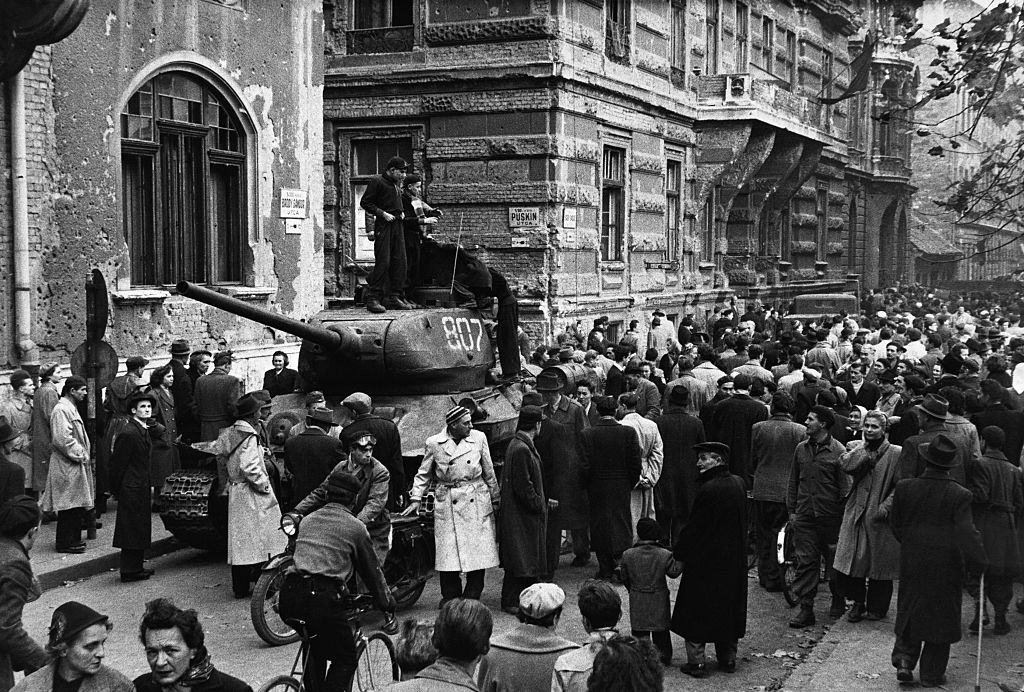
Street by street, the anti-Communist revolution in Hungary unfolded amid shattered plaster and scarred façades, and the captured Russian tank in the center of this scene becomes an unmistakable symbol of that sudden reversal of power. A thick crowd presses in from every direction—workers, elderly onlookers, men in caps, women in heavy coats—turning a war machine into a public spectacle. On the turret, a few figures climb and balance as if to claim the moment, while the surrounding buildings bear the pockmarks and grime of recent fighting.
The composition draws the eye along the cannon’s long line and into the dense mass of faces, suggesting both triumph and uncertainty in equal measure. People gather not in a tidy parade but in a rough, living knot, pausing their ordinary errands—bicycles and street traffic squeezed to the edges—to watch history being negotiated at arm’s length. The tank’s markings, the smoke-darkened street, and the close-packed bodies create a powerful record of a revolution that was fought not only with weapons, but with crowds willing to occupy the public space.
For readers searching for historical photos of the Hungarian Revolution, Soviet tanks in Budapest streets, or Cold War uprisings in Eastern Europe, this image offers a visceral snapshot of civilian defiance and the fragile joy of a captured enemy vehicle. It also hints at the deeper story behind the title: a civil struggle where hopes rose quickly, even as the costs were written on the walls around them. In this single frame, the line between battlefield and neighborhood dissolves, reminding us how revolutions are lived—up close, shoulder to shoulder, in the streets.