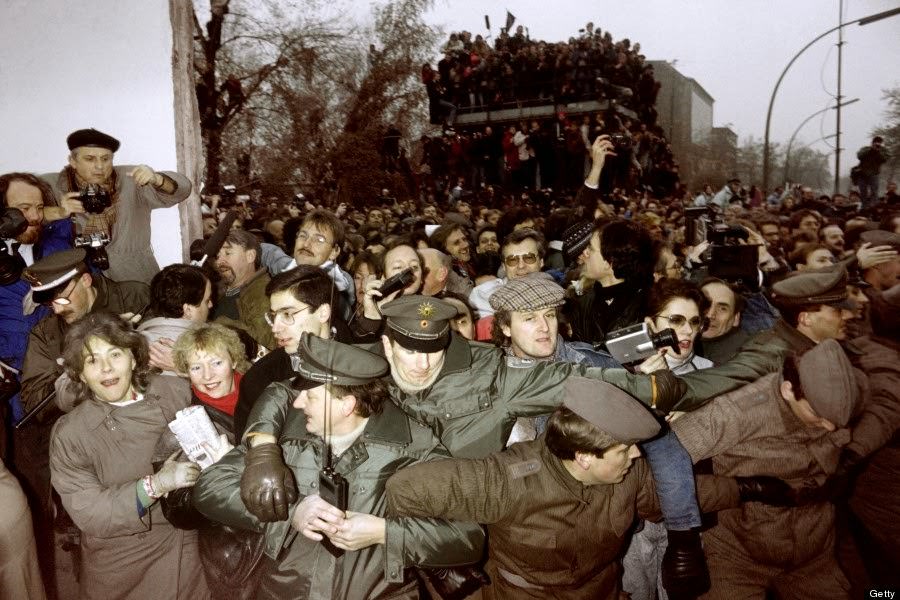
At Potsdamer Square, the recent opening in the Berlin Wall turns into a tight, surging corridor of bodies, winter coats, and raised cameras. East Berliners press forward in waves, their faces caught between disbelief and determination as they push toward the gap that only days earlier would have been unthinkable. Photographers and onlookers perch above the crush, signaling just how quickly a local passage became a world-historic spectacle.
A line of police—East and West German uniforms side by side—forms a human barrier to contain the flow and keep the crossing from collapsing into panic. Linked arms and braced shoulders meet the force of the crowd, not as a battle line in the traditional sense, but as improvised crowd control in a moment when authority itself is being rewritten. The tension is visible in the bodies leaning, the hands gripping, and the urgent glance of people trying to move while still absorbing what’s happening.
Dated in the title to November 12, 1989, the photograph captures the fragile mechanics of a revolution that was largely peaceful yet intensely physical. It’s a reminder that the fall of the Berlin Wall wasn’t only a symbolic event; it unfolded through checkpoints, police cordons, and ordinary people insisting on passage. For readers searching Berlin Wall opening, Potsdamer Platz 1989, or East and West German police crowd control, this scene offers an unvarnished look at how reunification began—one crowded step at a time.