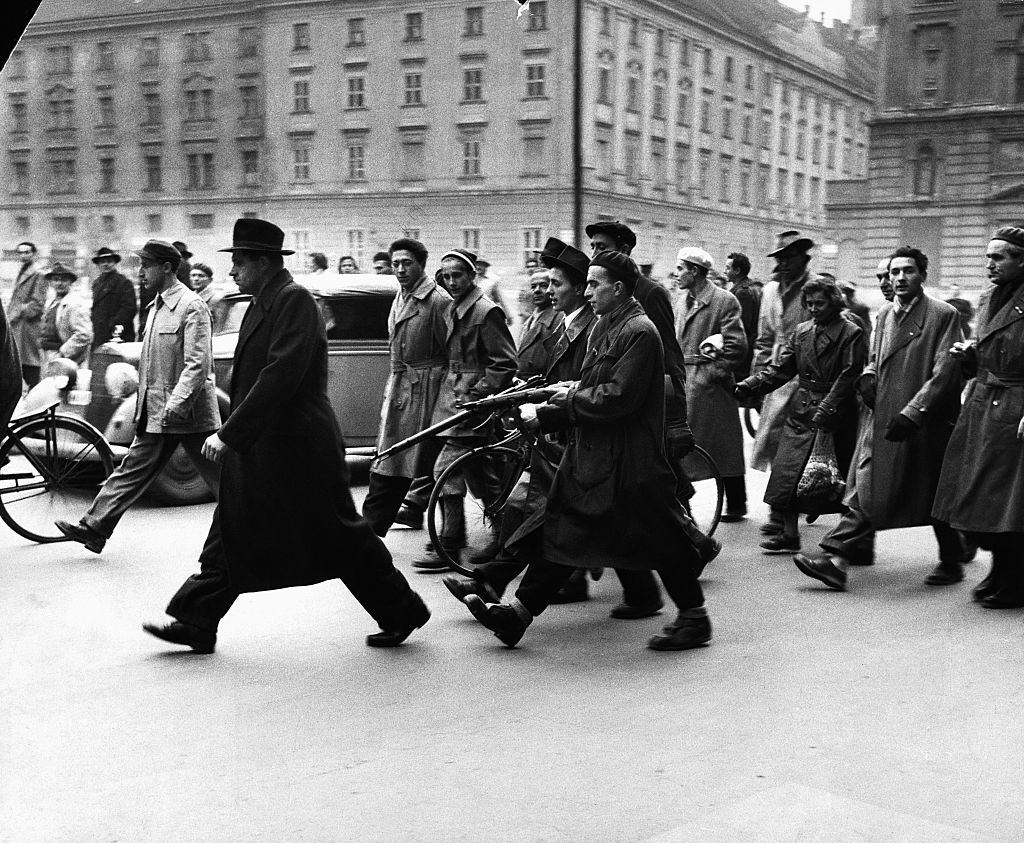
Along a broad city street lined with imposing apartment blocks, a tense procession pushes forward through a watching crowd. Men in heavy coats and hats stride in step, one gripping a rifle as bicycles and a car sit trapped at the edge of the commotion. Faces turn toward the center of action, where the arrest of a suspected secret police man becomes a public moment rather than a quiet, hidden one.
The title points to the Hungarian Revolution of 1956, a brief and explosive uprising in which authority fractured and ordinary citizens seized control wherever they could. In scenes like this, the boundary between protest, civil conflict, and improvised justice blurred rapidly, with uniforms replaced by armbands, civilian clothing, and whatever weapons could be found. The atmosphere suggests urgency and uncertainty, the kind that makes a city’s everyday rhythms—traffic, errands, conversation—suddenly feel fragile.
Viewed today, the photograph reads as a snapshot of power reversing direction, if only for a moment. It also hints at the larger story of 1956: fear of surveillance, anger at repression, and the dangerous hope that change might be wrested from the state in the open street. For readers exploring Cold War history, civil wars, and the Hungarian uprising, this image offers a stark reminder that revolutions are lived at ground level, step by step, under the gaze of neighbors.