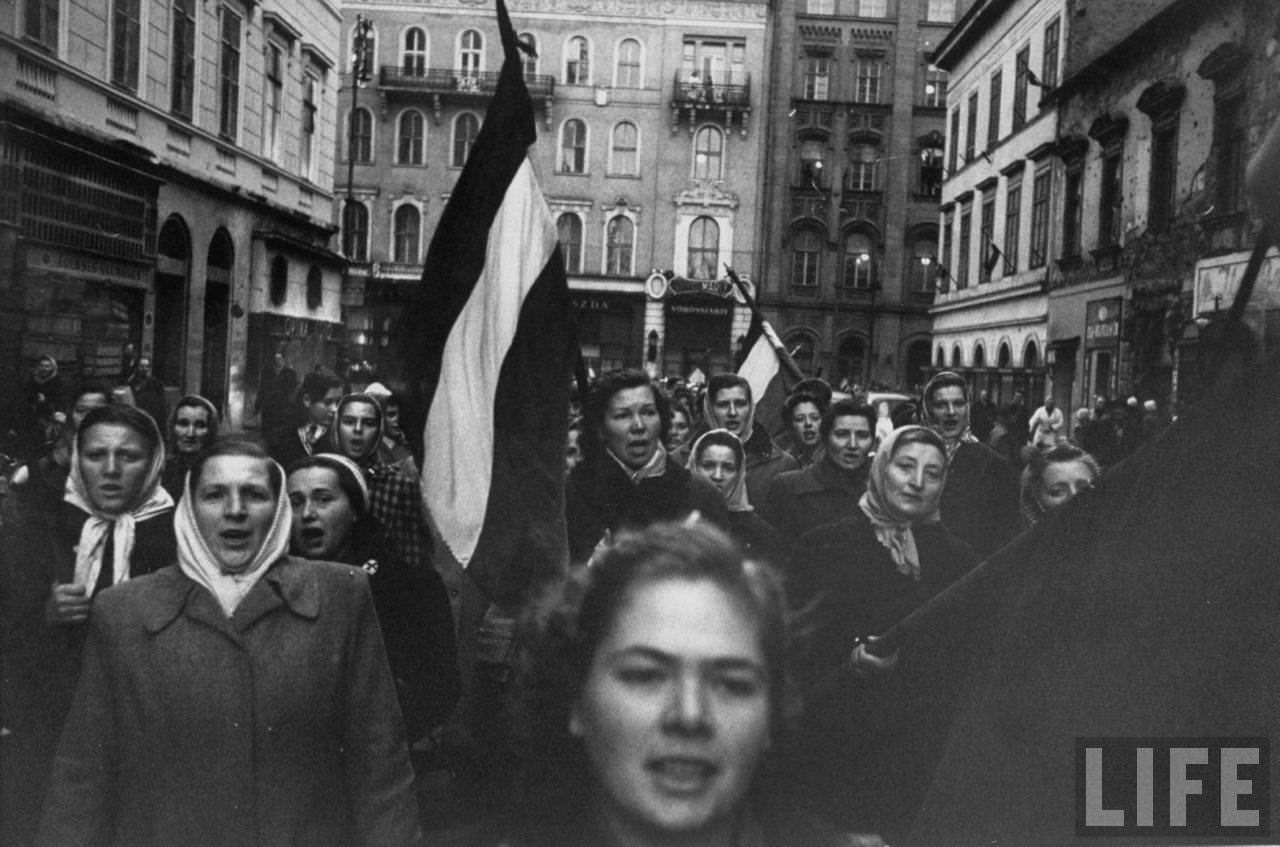
A narrow Budapest street becomes a corridor of defiance as rebel demonstrators surge toward the camera, faces set with urgency and resolve. Hungarian flags rise above the crowd, their bold stripes cutting through the gray tones, while the surrounding apartment façades and shopfronts frame the march like a canyon of stone and glass. The scene feels crowded and immediate, the kind of moment when ordinary city life gives way to history in motion.
Women in headscarves and men in heavy coats press shoulder to shoulder, suggesting a movement that reached beyond student circles into families and neighborhoods. Open mouths and forward-leaning postures hint at chants or shouted slogans, a collective voice taking shape amid the tension of a revolution. Even without visible weapons or barricades in this frame, the mood is unmistakably confrontational—public space reclaimed by people who no longer accept silence.
Set against the backdrop of a Soviet-backed Hungarian regime, the photograph speaks to the wider Cold War struggle over sovereignty, censorship, and political control in Eastern Europe. For readers searching Budapest revolution photos or Hungarian uprising street scenes, this image offers a human-scale view of civil conflict: not generals and maps, but citizens advancing together under their national colors. It’s a reminder that revolutions are lived at street level, where courage and uncertainty travel side by side.