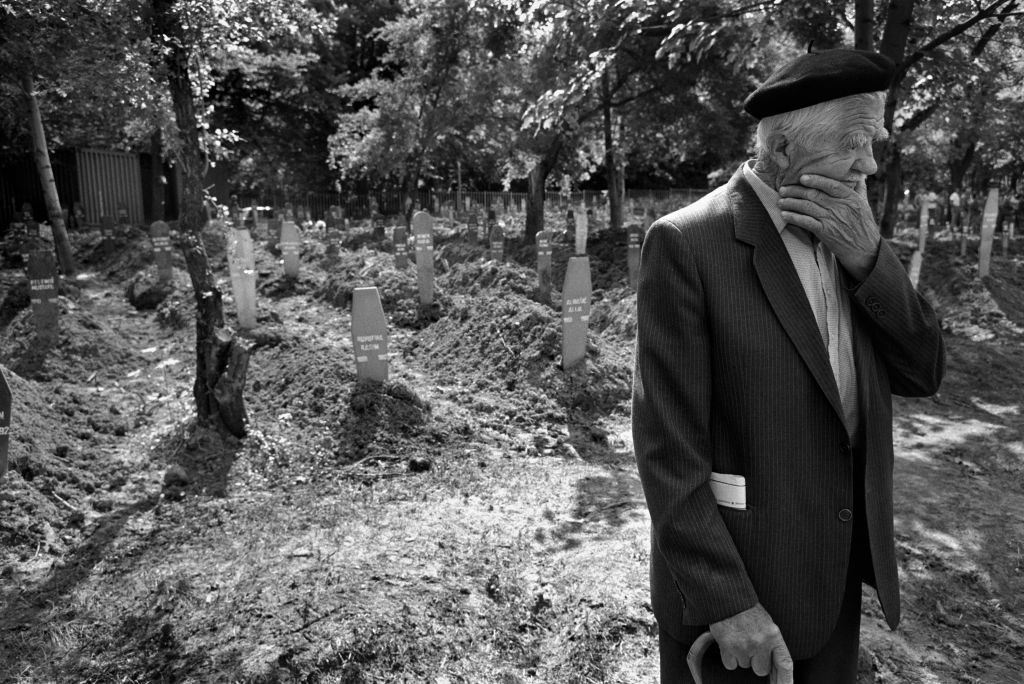
Under the shade of spring leaves, an elderly man stands at the edge of freshly turned earth in a Sarajevo cemetery, his hand drawn to his face as if weighing words that cannot be spoken. Rows of simple grave markers recede behind him, their repetition turning the landscape into a ledger of loss. The quiet posture, the cane, and the neatly worn jacket suggest a private pilgrimage—one made heavier by the surrounding evidence of recent deaths.
April 1994 places the scene squarely within the Bosnian War, when Sarajevo’s long siege made cemeteries expand and daily routines shrink to essentials. The ground appears uneven and newly worked, with narrow mounds aligned in succession, a detail that underscores how rapidly grief was being registered in the city. In this frame, civil war is not rendered through explosions or armed men, but through the aftermath: earth, markers, and the solitary figure left to remember.
For readers searching for Sarajevo 1994 photos, Bosnian War history, or civilian life during the siege of Sarajevo, the image offers a stark, human-scale document. It captures how mourning and survival occupied the same streets and parks, and how public spaces became places of burial as communities struggled to cope. The man’s averted gaze invites us to pause with him, reflecting on what war does to families, neighborhoods, and the meaning of peace.