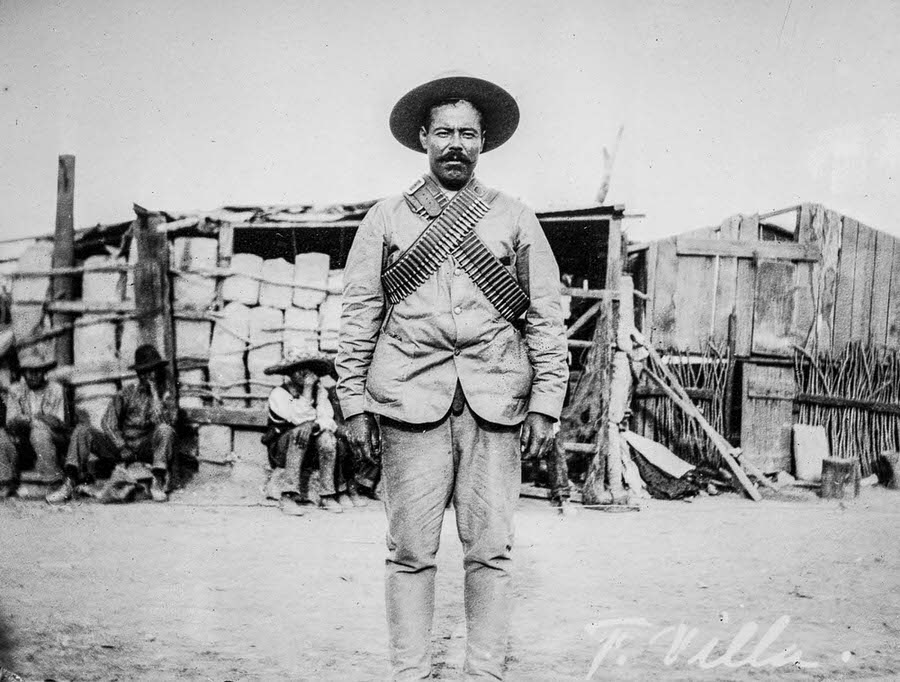
Centered in the frame, Pancho Villa stands in a broad-brimmed hat with bandoliers crossed over his chest, posed with a steady, unsmiling calm that feels both deliberate and defiant. Behind him, a rough barricade of stacked materials and makeshift fencing hints at a city turned into a battleground, where ordinary spaces were repurposed for survival. A few figures linger in the background, partially in shadow, underscoring how conflict pulls everyone—fighters and bystanders alike—into its orbit.
The title ties this moment to the capture of Ciudad Juarez, a pivotal episode often discussed in the wider sweep of the Mexican Revolution and related civil wars. Rather than showing movement or gunfire, the photograph leans into the aftermath and the posture of authority: a commander presented as the focal point, with the improvised fortifications serving as visual evidence of urban fighting. The composition turns military gear, clothing, and setting into a concise statement about power, uncertainty, and control at a contested border city.
For readers searching the history of Pancho Villa, Ciudad Juarez, and revolutionary-era conflict photography, the details here are especially evocative: the crossed ammunition belts, the dust underfoot, and the stark, utilitarian backdrop. It’s a reminder that “civil wars” are not only fought in grand campaigns but also in cramped streets and temporary defenses built from whatever is at hand. Seen today, the image invites a closer look at how revolutionary leaders were documented—and how such photographs helped shape public memory of struggle and victory.