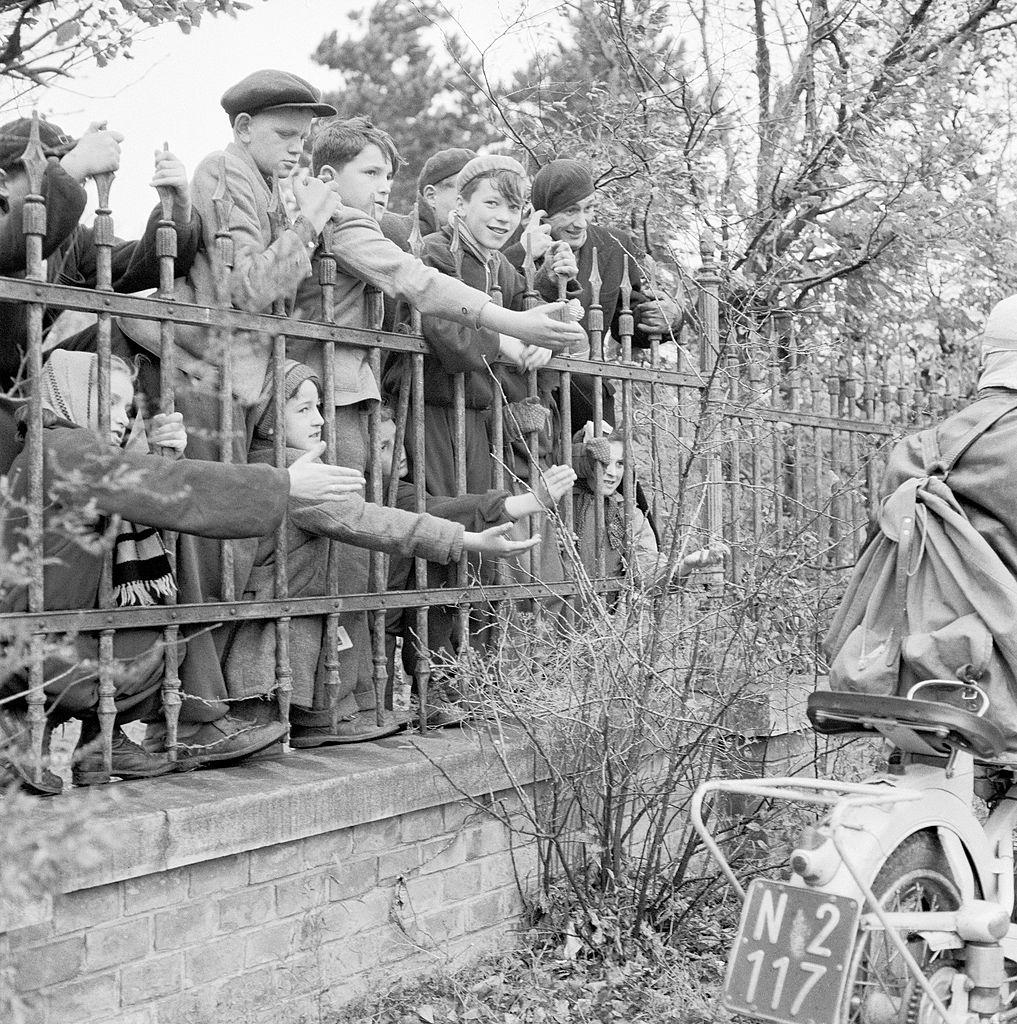
Behind an iron fence, a cluster of Hungarian refugee children leans forward with outstretched hands, their faces a mix of curiosity, strain, and sudden flashes of amusement. Caps and headscarves hint at cold weather and scarce comforts, while the tight crowding suggests the routines of camp life—waiting, watching, and trying to catch a moment of attention from the road outside. The fence becomes more than a barrier; it’s a line between confinement and the everyday movement of the world beyond.
On the right edge, a motorbike and rider pass close enough to draw the children’s eyes, turning a simple arrival into an event. Several small palms reach through the bars as if asking for a greeting, a gift, or simply recognition—an intimate gesture that speaks to displacement without needing words. In 1956, as violence and political upheaval pushed families into flight, camps in Austria became temporary havens where childhood carried on under the shadow of uncertainty.
Placed within the broader story of civil wars and Cold War-era crises, this photograph offers a grounded, human-scale view of the Hungarian refugee experience. It invites readers to consider what “refugee camp” meant in practice: crowded edges, improvised boundaries, and children negotiating hope in brief encounters. For anyone exploring 1956 Hungary, Austrian relief efforts, or the history of European displacement, the image holds a powerful reminder that history often turns on the smallest exchanges across a fence.