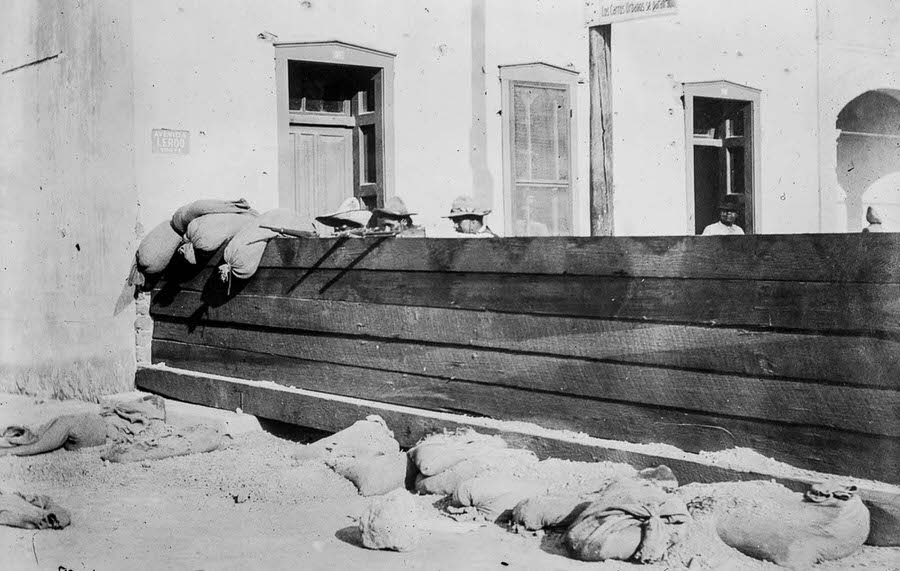
Hard timber planks form a makeshift wall across the street, braced with sandbags piled high in the dust, turning an ordinary stretch of Ciudad Juarez into a fortified position. Behind the barricade, helmeted figures keep low, their faces mostly hidden as they peer over the rough boards, while a plain stucco façade with shuttered windows stands pocked with the scars of gunfire. The photo’s stark contrast between domestic architecture and improvised defense conveys how quickly a city can be reshaped by civil war.
Rebels are said to have captured this federal barricade, and that detail changes how the scene reads: not merely a defensive line, but a trophy of shifting control. The sandbags slumped in the foreground and the worn edges of the wood suggest urgent construction under pressure, a fortification assembled with whatever could be hauled into place. Even the quiet doorway and shadowed windows feel tense, as if the building itself has become part of the battlefield.
Ciudad Juarez’s border-city setting has long made it a crossroads of politics, trade, and conflict, and this image places that larger story at street level. For readers searching for Mexican Revolution-era photography, civil wars, or urban warfare defenses, the photograph offers a vivid example of how fighters adapted city blocks into strongpoints. It lingers as a reminder that battles are not only fought on distant fronts—they can unfold against the walls of everyday life, leaving marks that outlast the moment of capture.