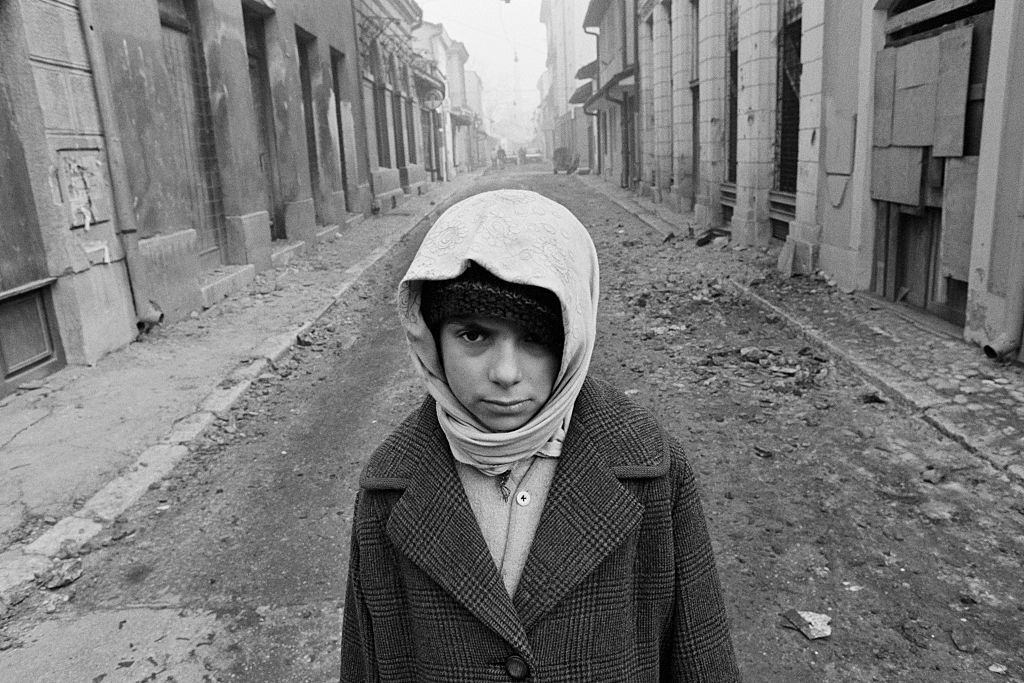
At the center of a narrow street in Sarajevo’s Old Town quarter, a bundled child stands alone, his head wrapped against the cold and his coat hanging heavy with the look of borrowed adulthood. Broken stone and scattered debris line the roadway, while shuttered doorways and worn facades recede into the distance, turning the city’s familiar architecture into a corridor of uncertainty. The boy’s steady gaze meets the camera without drama, as if survival has become a daily routine rather than a headline.
Mirza Mangajic is described as only ten years old, living with his grandmother and carrying the unbearable weight of not knowing what happened to his parents and sisters. The composition reinforces that separation: the long, empty perspective behind him suggests absence as much as place, and the rough street surface hints at recent violence without needing to show it directly. In the context of civil wars, the photograph speaks to the way conflict reduces childhood to essentials—warmth, shelter, and news that never arrives.
For readers searching the history of Sarajevo during wartime, this image offers a stark, intimate entry point into civilian life amid siege-like conditions, displacement, and fractured families. The Old Town setting matters too, because it contrasts centuries of urban continuity with the sudden fragility of the present moment captured here. More than a record of destruction, the photo preserves a human story: a boy and his grandmother enduring, waiting, and navigating a city where every street can feel like the distance between loved ones.