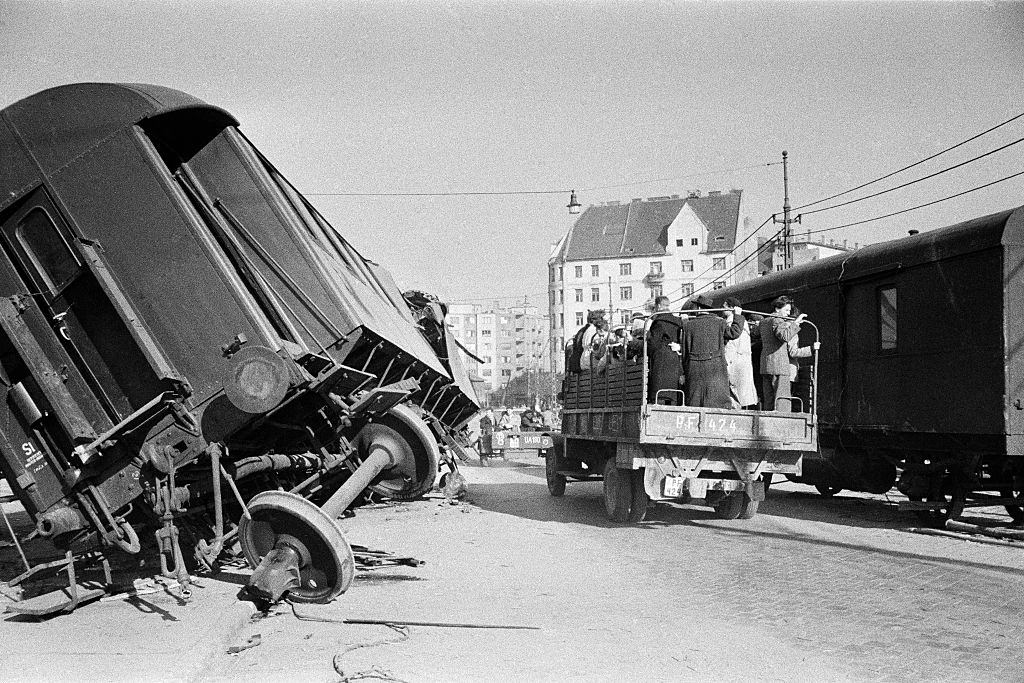
A derailed railcar lies crumpled at the edge of a city street, its bogies twisted and metal framing thrown askew, while a second carriage sits rigidly on the tracks nearby. In the foreground the wreckage feels abrupt and intimate—broken parts and scattered debris pressed up against everyday pavement—yet the background’s apartment blocks and overhead lines remind us this violence unfolded in ordinary neighborhoods. The composition pulls the eye from the ruin on the left toward the open roadway on the right, where movement continues despite the disruption.
Along that road, a flatbed truck carries bundled civilians, some standing and gripping the rails as they pass the wreck, their faces turned toward the scene with a mix of urgency and wary attention. The contrast between damaged infrastructure and improvised transport speaks to the Hungarian Revolution of 1956 as a struggle that was fought not only with weapons and slogans, but also through disrupted logistics, shattered communications, and the improvisation of daily survival. Nothing in the frame looks ceremonial; it feels like a moment caught between action and aftermath, when choices had to be made quickly.
As a historical photo, it offers a stark entry point into Cold War-era unrest and the human scale of urban conflict often summarized too neatly as “civil wars.” The wrecked train and crowded truck evoke themes central to 1956—street-level resistance, rapid troop and civilian movement, and the fragility of public systems under pressure—without needing captions to supply drama. For readers exploring the Hungarian Revolution of 1956, this image anchors the story in tangible evidence of disruption, resilience, and the precarious line between normal life and upheaval.