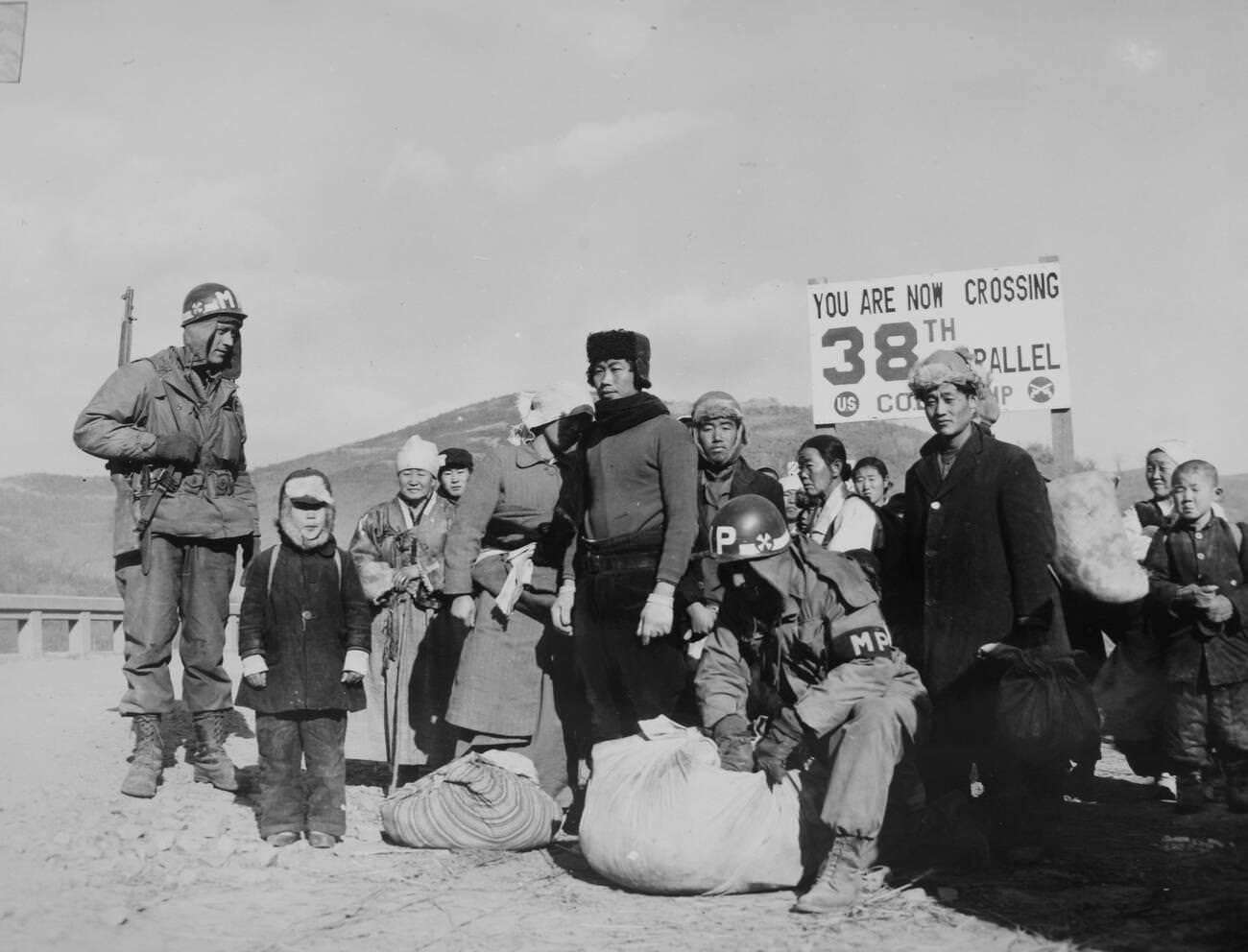
Beneath a roadside sign reading “You are now crossing 38th Parallel,” a tense checkpoint scene unfolds as military police in helmets and heavy field jackets halt a group of civilians on the move. Bundles and sacks sit on the ground like hurriedly packed lives, while adults and children stand close together, waiting as a uniformed officer inspects their belongings. The open sky and distant hills offer no shelter from the scrutiny, underscoring how exposed refugee flight could be in the Korean War era of the 1950s.
Contraband searches were more than routine policing; they were a wartime attempt to control movement across a line that had become both a boundary and a battleground. The 38th Parallel—once a political divider—turned into a corridor of displacement where security fears collided with humanitarian need. In the faces turned toward the camera and the guarded body language of those being searched, the photo hints at the uneasy balance between protecting a front and managing a civilian exodus.
For readers interested in civil wars, refugee history, and Cold War border enforcement, this image offers a vivid entry point into everyday realities behind the headlines. It reminds us that large geopolitical decisions often filtered down to simple, stark moments: a bag opened, a pocket checked, a family paused mid-journey. Seen today, the checkpoint at the 38th Parallel stands as a powerful symbol of division, survival, and the hard choices forced on ordinary people in a fractured land.