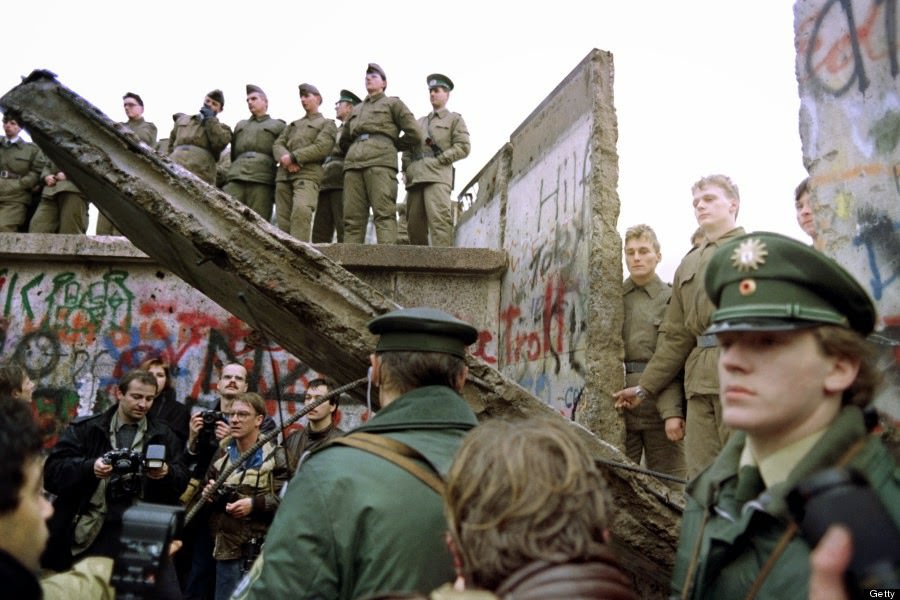
Perched along a jagged, newly fallen slab of concrete, East German border policemen—Vopos—stand watch as if the old order might still be steadied by posture alone. Below them, the Berlin Wall’s torn edge angles downward, its rebar and fractured surface turning a once-impenetrable barrier into a chaotic ramp. Fresh graffiti and paint marks compete with raw gray concrete, a vivid reminder that the Wall was as much a canvas of protest as it was an instrument of control.
In the foreground, two West German policemen hold their line, preventing people from approaching the break while onlookers and photographers press in, hungry for a closer look at history in motion. Their stance is cautious rather than triumphant, reflecting the uncertainty of 11 November 1989, when the euphoria of opening borders still ran alongside concerns about crowd safety and escalation. The visual tension between uniforms on both sides underscores how quickly authority had to adapt to a world changing faster than regulations could be rewritten.
Between the rubble, the cameras, and the clustered faces, the scene reads like a hinge moment of the Cold War: the Wall is down in one place, yet control and fear have not vanished overnight. For readers searching for Berlin Wall 1989 photos, East and West German police, or the immediate aftermath of the Wall’s collapse, this image captures the liminal space where division remained visible even as it began to crumble. It’s a reminder that reunification was not a single act, but a series of guarded, crowded, uncertain steps taken amid concrete dust and watchful eyes.