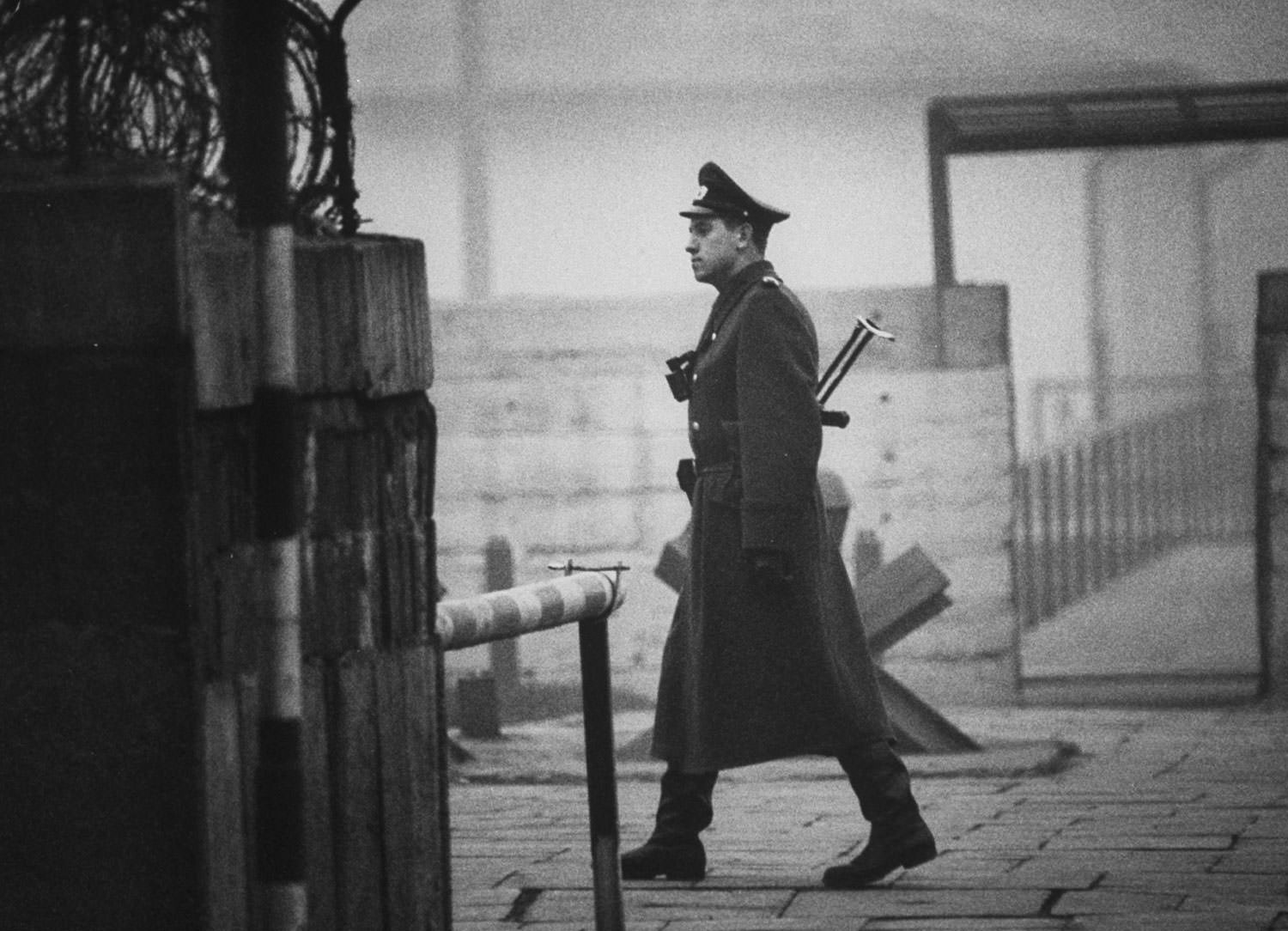
A lone East German policeman strides through the tense no-man’s-land of Checkpoint Charlie, his long coat and peaked cap forming a stark silhouette against improvised barriers and open framing. Coils of barbed wire and stacked obstacles crowd the foreground, turning an ordinary walk into a guarded passage through one of the Cold War’s most watched crossings. The scene feels both spare and claustrophobic, built from concrete, metal, and suspicion.
Known in the German Democratic Republic as the Volkspolizei—“people’s police,” or Vopo—such officers became the human face of a hardening border, tasked with presence as much as patrol. The submachine gun slung at his side underscores how quickly politics translated into everyday militarization, even at the level of a single uniformed figure moving from post to post. In October 1962, the air around Berlin’s dividing line was charged, and even routine movements carried the weight of international rivalry.
Checkpoint Charlie sits in memory as more than a traffic point; it was a stage where East and West measured each other in rules, paperwork, and visible force. Photographs like this anchor that vast geopolitical story in physical details—boots on paving stones, a glance forward, the harsh geometry of temporary walls. For readers searching Berlin Wall history, Cold War Berlin, or life at Checkpoint Charlie, this image offers a quiet, unsettling reminder of how division was enforced one step at a time.