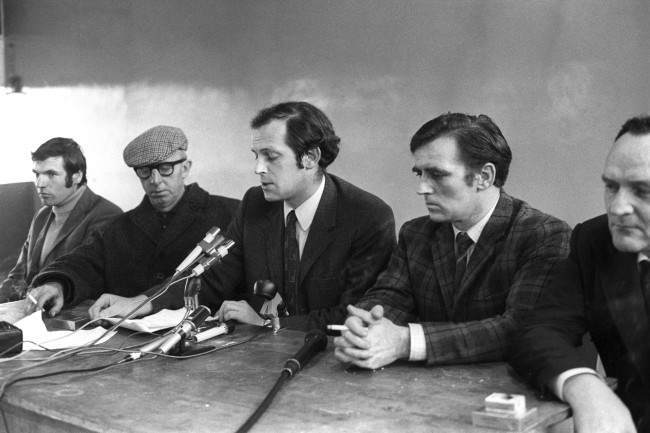
Set behind a scuffed table and a knot of microphones, Joe Cahill sits at the centre of a tightly packed panel, leaning forward as if to press his words through the room. The men flanking him—some in plain suits, one in a flat cap—face the same direction with guarded expressions, their hands clasped or resting on papers. The setting, identified in the title as a school gym in Ballymurphy, Northern Ireland, feels improvised yet purposeful, a place briefly turned into a stage for political messaging.
Dated 13 August 1971 in the post title, the moment is framed as a press conference in which Cahill, described as a chief of the Provisionals in Belfast, challenged claims made by the army only hours earlier that the IRA were “virtually beaten.” That tension sits plainly in the photograph’s body language: the forward tilt toward the microphones, the set jaws, the careful stillness of men aware that every sentence may be repeated far beyond the room. It’s an image about narrative control as much as it is about the individuals at the table.
Viewed today, the photograph serves as a stark entry point into the media battles and public statements that ran alongside street-level conflict during the Troubles. The close clustering of officials, the sparse interior, and the press equipment emphasize how swiftly ordinary spaces could become arenas for competing versions of events. For readers searching Ballymurphy, Belfast, Joe Cahill, Provisional IRA, and 1971 press conference history, this scene captures the charged intersection of propaganda, politics, and uncertainty that shaped those years.