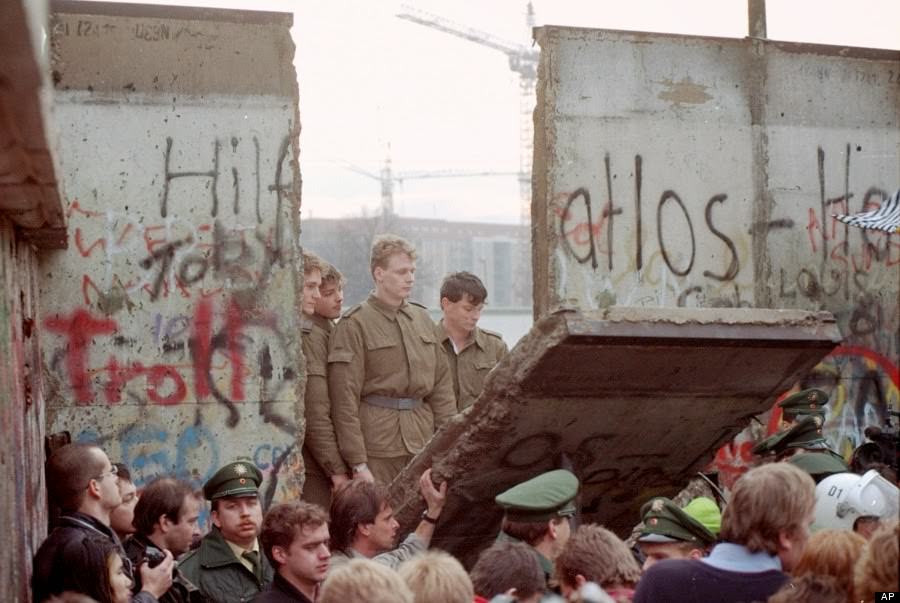
Graffiti-splashed slabs of concrete loom over a dense crowd as a freshly opened gap in the Berlin Wall draws every eye toward what had long been forbidden to see. The title’s moment—East German border guards peering through a hole after demonstrators pulled down a segment near the Brandenburg Gate—captures the uneasy transition from rigid separation to sudden permeability. Faces press in from below, while uniformed men stand amid broken edges and dust, the wall’s surface reading like a public ledger of anger, jokes, and hope.
Tension runs through the scene in small details: the guards’ wary posture, the crush of onlookers, and the heavy panel being maneuvered in a space that was never meant for crowds. What had functioned as a cold boundary becomes, in an instant, a stage where authority and popular will collide without the neat choreography of official ceremonies. The hole itself is the story—an improvised window that turns the Wall from an instrument of control into an object being dismantled by ordinary hands.
November 1989 remains synonymous with the fall of the Berlin Wall, and this file picture speaks to that wider upheaval while staying grounded in the messiness of the street. For readers interested in Berlin Wall history, the end of East Germany’s border regime, and the symbolism of Brandenburg Gate, the photograph offers a vivid reminder that political earthquakes arrive through physical acts: concrete lifted, barriers breached, and the watchmen forced to look through what they once enforced. Even without identifying individuals, the image preserves the atmosphere of a civil conflict resolved not by battlefield lines, but by the collapse of a dividing line in the heart of a city.