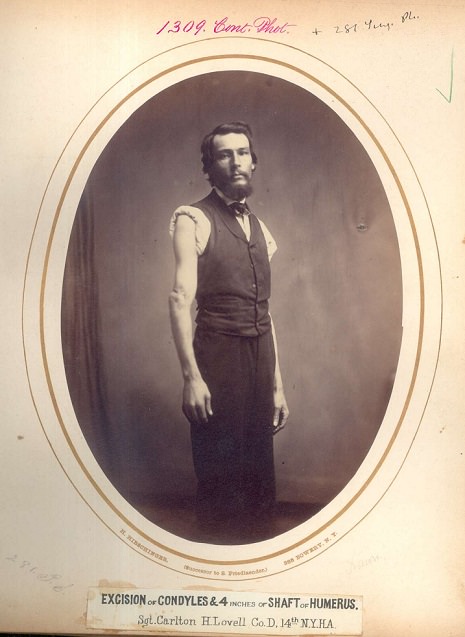
Standing in a studio setting with a steady, unsentimental gaze, Sgt. Carlton H. Lovell of the 14th New York Heavy Artillery is presented not in full uniform but in clothing that makes the human cost of war unmistakable. The oval mat draws the eye to his posture and face, while the bare upper arm—bandaged and altered—quietly tells its own story. A period caption at the bottom identifies the subject and offers clinical detail about injury and surgery, reflecting how Civil War wounds were documented as both personal tragedy and medical record.
Wounded on June 2, 1864, during the Battle of Cold Harbor in Virginia, Lovell’s portrait connects directly to one of the war’s most brutal and contested engagements. Cold Harbor is often remembered for catastrophic casualties and the grim arithmetic of frontal assaults, yet photographs like this shift the focus from battlefield overviews to individual lives changed in an instant. The 14th New York Heavy Artillery, like many units drawn into intense fighting, left behind not only rosters and reports but also men whose bodies became living testimony to the conflict.
Period photography and its accompanying text reveal a culture grappling with modern warfare: surgeons, soldiers, and families trying to make sense of shattered limbs and altered futures. The careful staging, the measured language, and the plain evidence of amputation illuminate how the Civil War was recorded for memory, medicine, and meaning. For readers searching for primary-source Civil War images, Cold Harbor history, or the experiences of New York artillerymen, this portrait offers a direct, sobering encounter with what “wounded” truly meant.