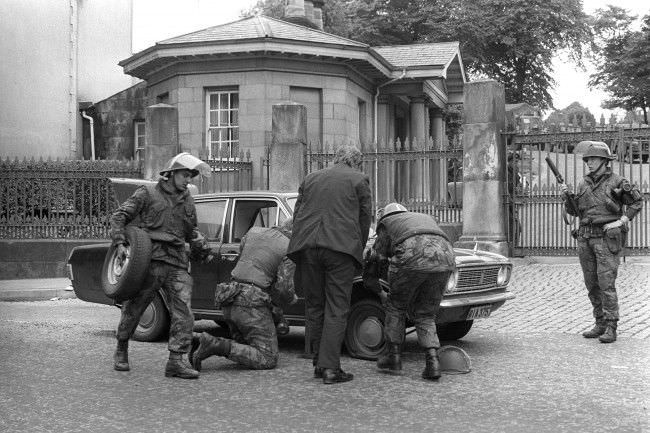
Just outside an Army base in Londonderry, a roadside problem becomes a small drama of routine discipline: soldiers cluster around a car with a flat tyre, one man lugging the spare while others crouch at the wheel to work the jack. The scene is framed by base gates and stout stone posts, with a compact guard building beyond, giving the moment an unmistakably official backdrop. Mud-streaked uniforms and helmets suggest they’ve been moving through rough conditions, yet the task at hand is as ordinary as any motorist’s misfortune.
A suited figure stands close to the action, hinting at the mixed civilian-and-military reality that often surrounded such installations during periods of unrest and heightened security. Nearby, an armed soldier keeps watch with measured distance, turning a simple repair into a reminder of tension in public space. The car’s bonnet and wheel area draw the eye, but the real story lies in the choreography—work hands busy at ground level while sentries and bystanders hold their positions.
For readers interested in Londonderry history, Army base life, and the everyday textures of conflict-era streets, this photograph offers an unusually grounded view. It’s not a parade or a headline event, but a candid glimpse of logistics and vigilance intersecting in a single city corner. Small incidents like a puncture can reveal a great deal about how soldiers operated, how communities navigated checkpoints and gates, and how normal life continued in the shadow of security.